Voice typing and dictation continue to shape how people write across Chrome, iOS, and Android. Users rely on these tools to draft faster, reduce typing strain, and stay productive in any app. Wispr Flow and Willow Voice are two AI-driven options built to make speech input feel more natural and conversational. This article explains how each tool works, how their workflows differ, and what you should consider when deciding which one fits your writing routine.
What Is Voice Typing and Dictation
Voice typing and dictation convert spoken words into written text as soon as you start talking. You can speak inside notes, browser fields, messages, or full-length documents and see text appear in real time. These tools make drafting easier when switching between tabs, working on multiple devices, or navigating long writing sessions.
Voice typing remains one of the strongest replacements for traditional keyboard typing. Many users rely on the same patterns found in voice typing, speech to text, and other input methods designed to make writing continuous without manual effort.
How AI-Based Dictation Developed
Early dictation required slow, careful enunciation, frequent pauses, and explicit commands for punctuation. Errors were common, long-form writing was tiring, and conversational phrasing often failed to transcribe correctly.
Modern AI dictation tools changed this completely. Wispr Flow, Willow Voice, and similar systems now use neural networks and context-aware language modeling to interpret grammar, sentence structure, and natural pacing. These advancements reflect the same improvements seen in tools like speech to text, where AI can smooth phrasing and understand intent more reliably than older rule-based systems.
What Wispr Flow and Willow Voice Are Designed For
Wispr Flow
Wispr Flow focuses on conversational voice typing. Its goal is to make dictation feel like speaking to another person. The system prioritizes fluid, uninterrupted speech and aims to deliver cleaned-up text without forcing the user to speak artificially slowly. Wispr Flow is especially popular for mobile-first dictation among users who want low-latency input on the go.
Willow Voice
Willow Voice provides a dedicated AI notepad interface. You speak into a focused writing space and receive a polished transcription that is ready to copy or export. Willow applies cleanup, grammar correction, and sentence-level refinement to improve readability. It is well suited for users who prefer a structured draft that they can paste into another app. Both tools excel at transforming natural speech into readable text, though they differ in how open or structured the workflow feels.
How These Tools Fit Into Everyday Workflows
Voice typing supports everyday writing tasks by making it easier to move between apps, devices, and research sources without breaking focus. Many people dictate directly inside Google Docs, Gmail, Notion, ChatGPT, and other browser-based writing tools, creating the same smooth drafting flow they rely on during busy email sessions or longer essay drafting. Speaking often helps you think through ideas more clearly, maintain momentum during complex writing, and produce full paragraphs more quickly than typing.
How Wispr Flow and Willow Voice Compare
Wispr Flow works well for users who want continuous, conversational input on mobile. Willow Voice provides a consistent environment for people who prefer to produce a full draft before moving text into their final document. Both tools behave reliably across devices and support extended writing in the same way users expect from steady dictation workflows when outlining essay sections, capturing long-form thoughts, or shaping early ideas into more detailed writing.
Accuracy and Cleanup Behavior
AI-powered dictation tools evaluate the meaning and structure of sentences rather than simply matching sound to a vocabulary list. This is what enables both Wispr Flow and Willow Voice to:
• predict contextually appropriate words
• insert punctuation without commands
• reduce filler words
• correct misheard phrases
• apply grammar smoothing for clearer drafts
These behaviors matter most during long-form writing where revision time can significantly impact productivity. Many of the same accuracy trends appear in tools similar to voice to text, which help clarify how modern dictation models maintain consistency across extended sessions.
Differences in Workflow and Platform Support
Wispr Flow emphasizes a mobile-centered, conversational experience. It is ideal for users who want to speak continuously and let the system interpret the flow of their thoughts. Willow Voice offers a more structured writing environment across Mac and iPhone where users can produce polished drafts before exporting them into emails, documents, or messages.
These differences reflect the same cross-device habits many users rely on when pairing dictation with features such as listening to material on a website before dictating summaries. Both tools attempt to support these multitasking environments, though each approaches the workflow in a distinct way.
Use Cases for Voice Typing as a Typing Replacement
Voice typing is one of the most effective replacements for manual typing, especially when projects involve:
• long paragraphs
• research summaries
• email correspondence
• idea capture
• outlines and planning
• hands-free writing during multitasking
Real-World Examples
• A student reviews readings on a website and dictates notes directly into a working document.
• A creator switches between writing apps while using voice typing to record script ideas.
• A professional outlines a report using dictation during a meeting.
• Users with wrist or hand strain rely on voice typing to minimize repetitive motion.
These examples demonstrate how both Wispr Flow and Willow Voice adapt to common writing tasks.
Tracing the Evolution
Early speech recognition tools could only understand digits or one word at a time. Continuous speech recognition began to improve as machine-learning models matured in the 1990s. These breakthroughs eventually supported the natural, fluid dictation experiences available today, allowing voice typing and dictation to become mainstream writing tools.
FAQ
Which tool feels more conversational?
Wispr Flow is generally the more conversational option because it emphasizes continuous speech and natural phrasing. Willow Voice focuses more on polishing the final text in a dedicated workspace.
Can both tools handle long-form writing?
Yes. Both Wispr Flow and Willow Voice work well for multi-paragraph assignments and structured responses, similar to the drafting approaches seen in dictation for essays.
Do these tools insert punctuation automatically?
In most cases, yes. Both systems interpret sentence boundaries and apply punctuation without requiring constant commands.
Do Wispr Flow and Willow Voice work inside browser-based editors?
Compatibility varies. Many users rely on dictation inside Google Docs and other online editors in the same way they use Google Docs voice typing tools.
Are these tools useful for quick email writing?
Yes. Dictation is particularly efficient for fast replies and structured messages, much like the workflows supported by dictation for emails.
Is voice typing accurate enough to replace keyboard typing?
Often. Accuracy depends on microphone quality, environment, and the underlying AI model, but modern dictation continues to outperform older options.
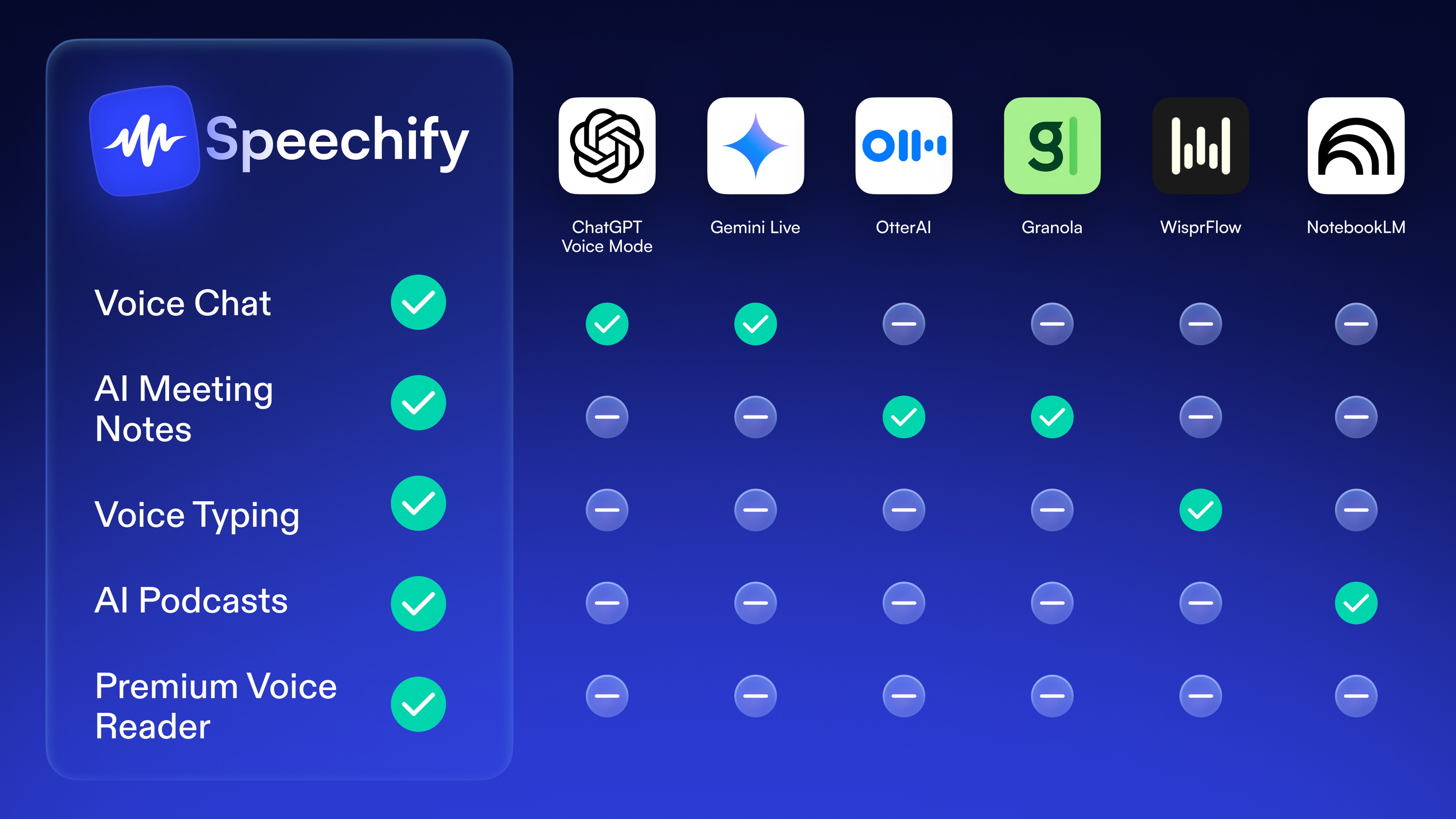
Why do some users choose Speechify over Wispr Flow?
Speechify is favored by users who want a full reading and writing environment in one place, including voice typing, text to speech, and a Voice AI Assistant for research and clarification.
Is Speechify Voice Typing Dictation free to use?
Yes. Speechify Voice Typing Dictation is completely free, and you can use it across Chrome, iOS, Android, and the Mac app without paying for additional software.