

Itaaliakeelne häälegeneratsiooni tehnoloogia muudab viisi, kuidas kaubamärgid, õpetajad ja sisuloojad jõuavad itaaliakeelsete kuulajateni täpselt ja kultuuriliselt asjakohaselt. AI arenguga on nüüd võimalik luua kõrgekvaliteedilisi, loomuliku kõlaga itaalia hääleülekandeid, mis peegeldavad piirkondlikke aktsente – nii põhja-, kesk- kui lõuna-Itaalias. Need hääleülekanded sobivad väga eri tüüpi sisule, näiteks podcastidele nagu E poi il silenzio - Il disastro di Rigopiano, YouTube'i videotele nagu PANDA BOI, e-õppele ja personaliseeritud klienditoele. See juhend avab itaalia häälegeneratsiooni võimalused ning toob esile parimad kasutajasõbralikud AI-häälegeneraatorid, et jõuda kuulajateni üle maailma.
Itaalia keelest
Itaalia keelt räägib ligi 67 miljonit inimest üle maailma ning see on tuntud oma meloodilise kõla ja piirkondlike murrete poolest. Itaalia kõnelejad eristavad hõlpsasti erinevate piirkondade aktsente, kus igal regioonil on oma sõnavara, väljendid ja grammatikareeglid. See mitmekesisus lisab itaalia häälegeneratsioonile keerukust – AI tööriistad peavad toetama murrete erinevusi, et pakkuda usutavat ja tuttavat heli. Allpool on toodud mõned piirkondlike aktsentide näited ja kuidas itaalia AI-häälegeneraatorid saavad nendega kohanduda.
Põhja-Itaalia aktsendid
Põhja-Itaalias on kõne selgem ja lühem, toon pehmem kui lõuna murretes. Näiteks Milano itaalia keel väldib lõunale omast laulvat intonatsiooni, sobides hästi ametlikuks või äriliseks itaalia hääleülekandeks, mis nõuab neutraalset ja hõlpsasti mõistetavat tooni. Itaalia AI-häälegeneraator, mis tabab selle selguse, sobib ettevõtetele, kes loovad õpetlikku või ametlikku sisu töötajatele või klientidele Põhja-Itaalias.
Kesk-Itaalia
Toscana itaalia keel, eriti Firenze aktsent, on tuntud kui Itaalia meedia- ja haridusstandard selguse ja ilmekuse tasakaalu tõttu. Seda aktsenti kasutatakse sageli audiobookides ja podcastides, kõla on pehmem – näiteks “casa” kostub “hasa”. Toscana aktsenti matkiv AI-generaator loob meeldiva, hõlpsasti mõistetava kõne, mis sobib kõigile, parandab ligipääsetavust ja haarab kuulajaid.
Lõuna-Itaalia aktsendid
Lõuna-Itaalia murded (napoli, sisilia jm) on tuntud oma rütmilise, meloodilise kõla ja rikka sõnavara poolest. Need aktsendid on muusikalisemad ja ilmekamad, tuues sõnadesse rohkem soojust. Itaalia TTS tööriistad, mis toetavad piirkondlikke aktsente, sobivad suurepäraselt autentseteks hääleülekanneteks lugude jutustamiseks, reklaamiks või muudeks mitteametlikeks projektideks, jõudes paremini lõunas elavate kuulajateni. Nii tundub sisu kuulajale oma ja lähedane.
Itaalia keele AI-häälegeneratsiooni liigid
Itaalia AI-häälegeneraatorid pakuvad kahte peamist võimalust: tekst kõneks (TTS) ja häälekloonimine. Mõlemat tehnoloogiat kasutatakse eri eesmärkidel ning valik sõltub projekti sihist, sihtgrupist ja soovitud häälest.
Loomutruud tekstist kõneks Itaalia hääled
Itaalia TTS tarkvara võimaldab kasutajal muuta teksti kõneks, pakkudes elutruusid hääli mitmes rakenduses, mis on inimhäälega äravahetamiseni sarnased. Tipptehnoloogia ning kõnesünteesi areng võimaldab TTS tööriistadel nüüd reprodutseerida itaalia hääli eri aktsentide ja hääletüüpidega. Näiteks Milano põhjaaktsendis kõlab “s” pehmemalt ja “o”-täht selgemalt häälduses, mille neutraalne toon sobib äriks või hariduseks. Lõuna-Itaalia Napolis või Sitsiilias pannakse rohkem rõhku intonatsioonile ja “e”-tähele, mis sobib hästi jutuvestmisse või meelelahutuslikku hääleülekandesse.
Itaalia häälekloonimine
Häälekloonimise tehnoloogia võimaldab luua isikupäraseid hääli, mis matkivad konkreetse inimese tooni, intonatsiooni ja stiili masinõppe abil. Itaalia mõjuisikutele ja brändidele on häälekloonimine hea võimalus hoida igas projektis ühtset kõlapilti. Näiteks tuntud Itaalia räppar Fedez, YouTuber ja podcaster, kes on tuntud oma avameelse stiili poolest saates Muschio Selvaggio, saaks kasutada häälekloonimist, et tema ainulaadne kõla oleks äratuntav igal pool. Nii saab ta olla korraga mitmes kanalis ilma igat klippi uuesti salvestamata, säilitades oma loomuliku, äratuntava hääle.
Itaalia AI-häälegeneraatorite eelised
Itaalia erineb paljudest keeltest märkimisväärse piirkondliku mitmekesisuse ja häälduse poolest, mis muudab keele väga ilmekaks. Kvaliteetsed itaalia AI-häälegeneraatorid suudavad neid eripärasid edasi anda, luues ehtsa ja kaasava heli. Olulisemad eelised Itaalia AI-häälegeneraatorite kasutamisel:
- Taskukohasus: Itaalia häälnäitlejate palkamine igale projektile või aktsendile võib olla kulukas, eriti väiksematele ettevõtetele ja sisuloojatele, kes vajavad pidevalt uusi salvestusi. Itaalia TTS pakub soodsat alternatiivi – sama kvaliteet ilma, et peaks iga piirkonna jaoks eraldi näitlejat palkama.
- Mastaapsus: Itaalia AI-häälegeneraatoritega saab toota suures mahus itaaliakeelset helisisu. Suured firmad nagu Eni või Telecom Italia saavad kiiresti luua TTS-i abil AI-hääleülekandeid klienditeeninduseks, koolituseks või tootetutvustuseks. Nii saab hõlpsalt jõuda kõigi kuulajateni, hoides ühtlasi kõrget kvaliteeti ja autentsust.
- Ehtsad naiste ja meeste hääled: Parimad itaalia TTS-generaatorid pakuvad nii mees- kui naisvalgikut, et bränd leiaks sihtrühmale sobiva hääle. Laste audiobooki jaoks sobib soe ja kutsuv naisääl, samas kui koolitusvideo puhul võib eelistada selget ja ametlikku meeshäält. Lai häälevalik aitab kuulajatega paremini sidet luua.
- Piirkondlikud aktsendid: AI-häälegeneraatorid, mis pakuvad regioonipõhiseid aktsente, aitavad sisuloojatel (nt Davie504 või Chiara Ferragni) jõuda kohalikeni palju autentsemalt. Valides Napoli või Milano kõla, saavad loojad pakkuda kuulajatele omast ja kultuuriliselt asjakohast kogemust.
Parim Itaalia AI-häälegeneraator loomuomasteks Itaalia häälteks
Speechify Studio on tunnustatud Itaalia AI-häälegeneraator oma loomuliku ja kohandatava itaalia hääle poolest. Speechify Studio’s itaalia aktsendigeneraator pakub palju erinevaid hääli ja tööriistu, millega saab luua kõrgekvaliteedilist itaaliakeelset helisisu, olgu see podcasti, tutvustava video või reklaami jaoks. Siin on mõned olulised omadused:
- Extensive language library: Speechify Studio supports over 200+ AI voices across languages, including Italian, French, Portuguese, German, Hindi, Dutch, Polish, Japanese, Spanish, and more. This language variety is advantageous for businesses or creators targeting a multilingual audience, as it enables seamless transition between different languages and ensures that Italian voice overs blend smoothly with other language content.
- Region-specific Italian accents: With Speechify Studio’s region-specific Italian accent options, users can select voices that accurately represent Northern, Central, or Southern Italian accents, allowing for a more culturally accurate and relatable experience for listeners. This is essential for businesses aiming to build trust and familiarity with audiences in specific Italian regions.
- AI voice cloning: Speechify Studio’s voice cloning capability allows users to replicate a specific voice, maintaining consistency across brand projects. This feature is ideal for Italian-speaking content creators or brands that need a recognizable voice for their content, such as YouTube channels or podcasts with established personalities.
- Customizable nuances: Italian is a gendered language, and Speechify Studio’s Italian AI voice generator can adjust pronouns, adjectives, and verbs to match the intended gender, ensuring a more personalized touch. This nuanced customization adds authenticity, particularly in languages like Italian where gender forms play a significant role in sentence construction.
- Multi-speaker support: Speechify Studio’s multi-speaker feature allows users to incorporate different voices within a single project. For instance, a storytelling podcast might use one Italian voice for narration and another for character dialogue, enhancing the storytelling experience and providing listeners with a more engaging audio experience.
Examples of How Speechify Studio Tailors Italian AI Voice Generation
Speechify Studio’s Italian AI voice generator brings authentic Italian speech patterns to life, adjusting its voices to suit regional dialects and linguistic nuances. Here are some of the ways it customizes Italian voice generation:
Formal vs. Informal Speech
In Italian, formal language (e.g., using “Lei” instead of “tu” for “you”) is common in professional or respectful settings, while informal language is used with friends or family. For instance, “How are you?” is “Come sta?” in formal settings but “Come stai?” informally. Speechify Studio’s Italian TTS voice generation adjusts language to fit the context, enhancing user experience by delivering appropriate tones and phrasing.
Regional Vocabulary Variations
Italian vocabulary often varies by region. For example, “bag” is “borsa” in general Italian, but in Neapolitan, it might be “borsa” or even a different slang term. With Speechify Studio, users can create Italian voice overs that incorporate these regional terms, enhancing relatability and cultural accuracy for listeners in different parts of Italy.
Unique Italian Expressions
Italian is rich with idiomatic expressions. For instance, “In bocca al lupo!” (Good luck, literally “In the wolf’s mouth!”) is a common phrase that doesn’t translate directly into English. Speechify Studio’s Italian AI voice generator can handle expressions like these, providing a more authentic voice over experience that resonates with Italian listeners.
Use Cases for Italian AI Voice Generators
Italian AI voice generators like Speechify Studio offer diverse applications for businesses, content creators, and educators looking to engage Italian-speaking audiences. Here are some key use cases:
Italian AI Voice Generator for Audiobooks
Italian audiobooks benefit immensely from AI voice generation by adding regional authenticity and personality to stories, making them resonate deeply with listeners. Platforms like Storytel and Audible leverage tools like Speechify Studio to offer narrations with Italian voices that vary by regional accent. For example, a Tuscan or Sicilian accent can make the setting more relatable and immersive, particularly in historical or region-specific tales.
Italian AI Voice Generator for Podcasts
Italian AI voices have empowered podcasters to streamline production, enhance quality, and bring cultural nuance into their shows. For example, a history podcast on Italy’s art and culture, such as Storia d'Italia, could use Speechify Studio to provide narrations in a Tuscan accent, which resonates well with audiences nationwide and adds an authentic touch. Italian TTS also allows podcasters to expand into multilingual formats, making it easier to reach Italian-speaking audiences outside of Italy.
Italian AI Voice Generator for Marketing Ads
For marketing campaigns, Italian AI voice generators bring a layer of cultural authenticity that is crucial for resonating with local audiences. Brands like Ferrero and Barilla, known for their deep Italian roots, can use Speechify Studio’s TTS voices to produce ads that incorporate region-specific expressions, tone, and familiarity. For instance, a Ferrero commercial can be delivered in a Northern Italian accent, lending a sense of heritage, while a Southern accent could create a warmer, more relatable approach in local campaigns.
Italian AI Voice Generator for Social Media Videos
Social media platforms like TikTok, Instagram, and YouTube Shorts thrive on quick, engaging content that captures audience attention immediately, and Italian AI voice generators are ideal for creating high-quality voice overs that resonate. Italian fashion brands, such as Gucci and Versace, for instance, can use Speechify Studio to produce Italian voice overs with accents or tonalities that match their brand's identity—whether formal, trendy, or conversational.
Italian AI Voice Generator for E-Learning
In the e-learning sector, Italian AI voice generators have transformative potential. Platforms like WeSchool and Docebo can integrate Speechify Studio's Italian voices to provide lifelike narration, making educational content more engaging and accessible for Italian-speaking students and learners. With regionally adaptable accents, Italian AI voices can cater to different demographics within Italy, using neutral or localized accents to aid comprehension based on the audience's needs.
Italian AI Voice Generator for IVR Systems
Interactive Voice Response (IVR) systems are crucial for businesses managing customer inquiries, and Italian AI voice generators like Speechify Studio can elevate this experience. Banks, telecom providers, and service companies in Italy can use AI-generated voices to create friendly, clear IVR interactions tailored to Italian-speaking customers. For example, companies like TIM or Unicredit could employ an Italian TTS system to ensure customers receive instructions and guidance in a warm, natural-sounding Italian voice.
How to Use Speechify Studio’s Italian Text to Speech AI Voice Generator
Creating an Italian text to speech voice over in Speechify Studio is simple. Follow these steps to get started:
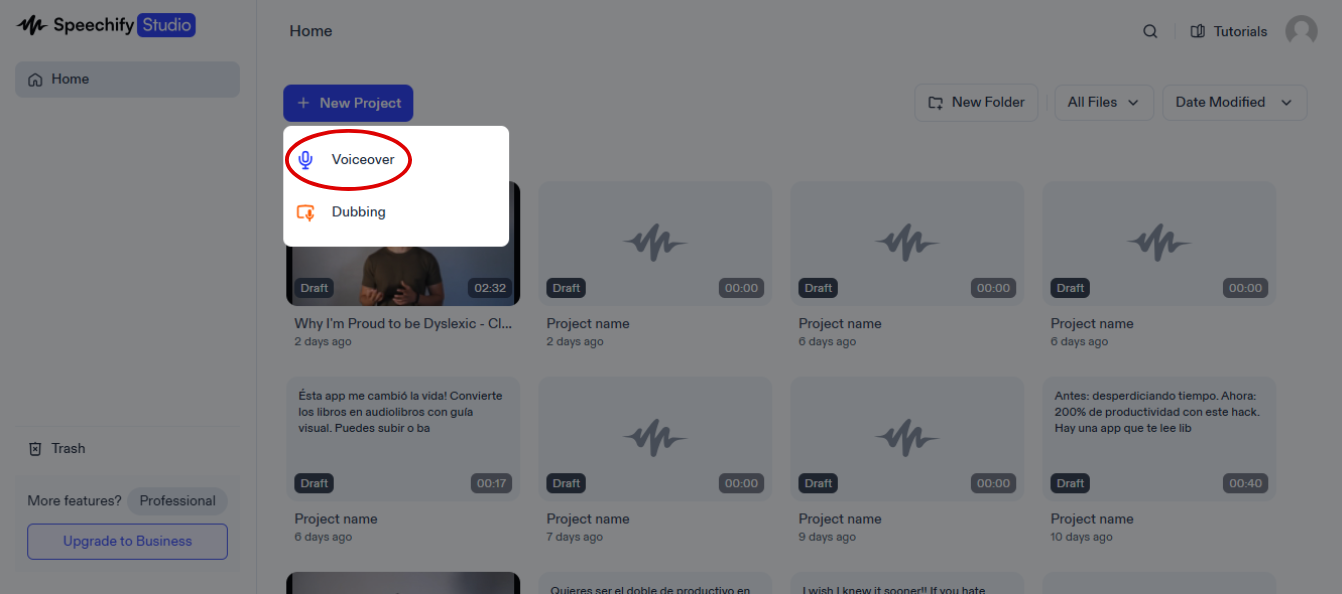
Start a new project: Click "New Project" and choose "VoiceOver" to begin.
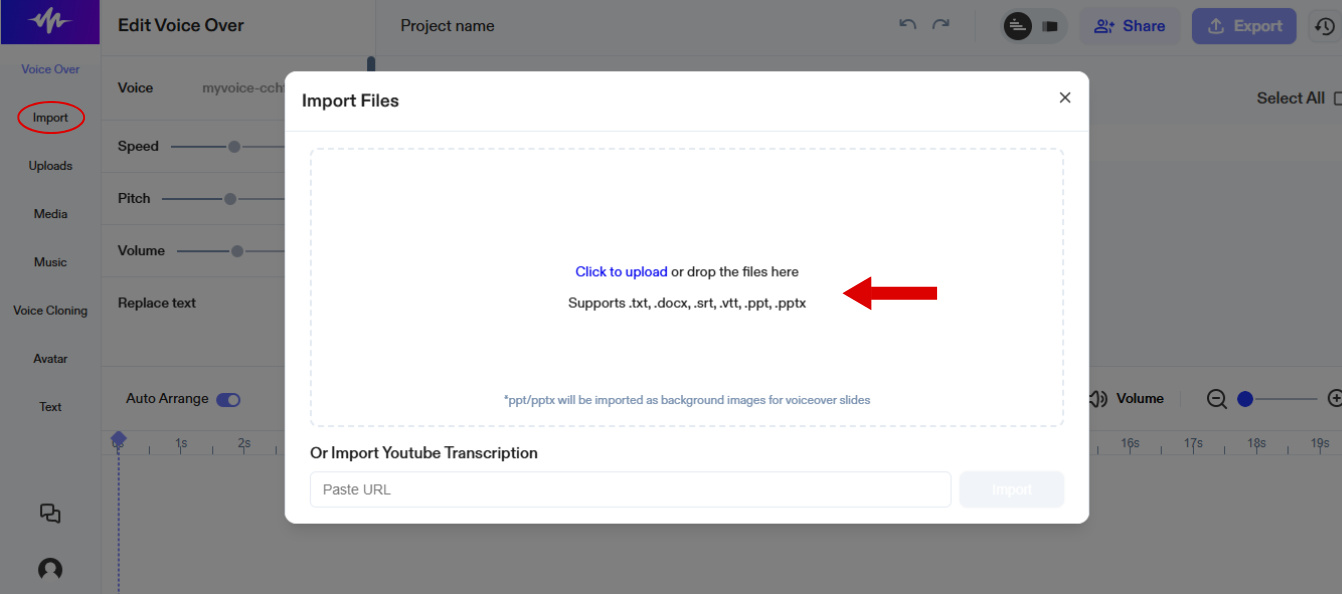
Upload your script: Use the "Import" button to add your script, which Speechify will use to generate the voice over automatically.
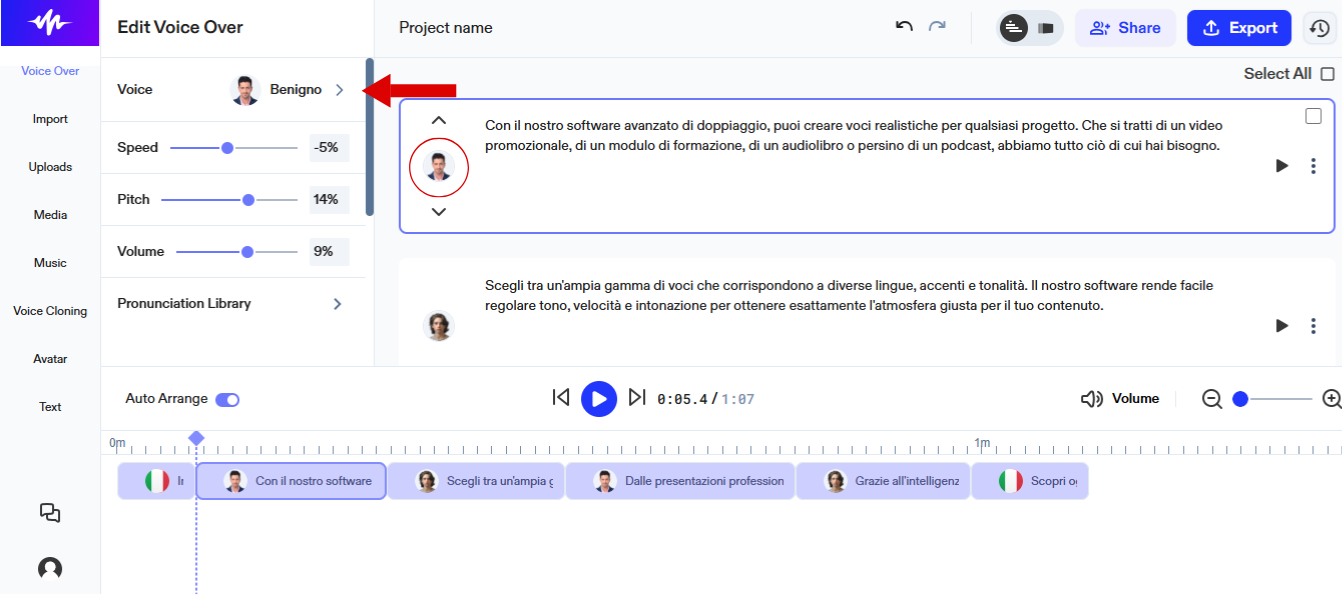
Select an Italian voice: Tap the icon next to your script to browse and choose your preferred voice in Italian, with options to suit various tones and styles.
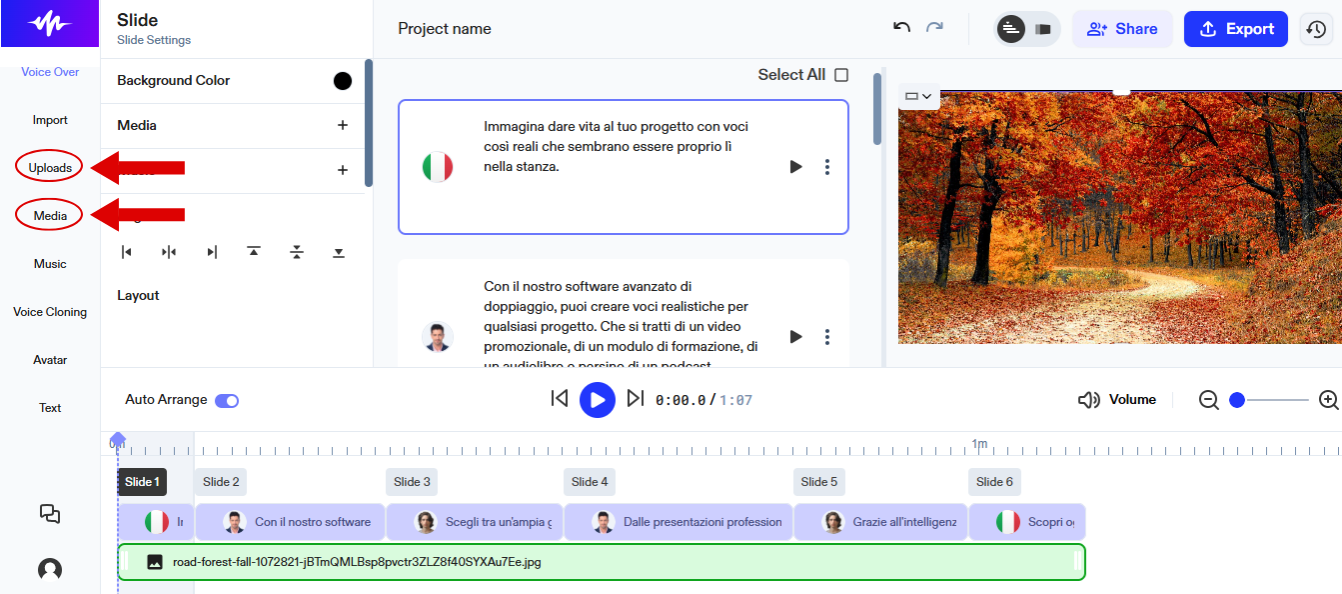
Add media: If needed, go to "Uploads" to add video files or images. You can also explore the "Media" or "Music" tabs to include stock footage or background music to enrich your project.
Edit your content: Under "Voice Over," you can adjust pitch, tone, and pronunciation to personalize the audio. Drag and drop elements in the workspace to align video clips or add AI avatars for more visual depth.
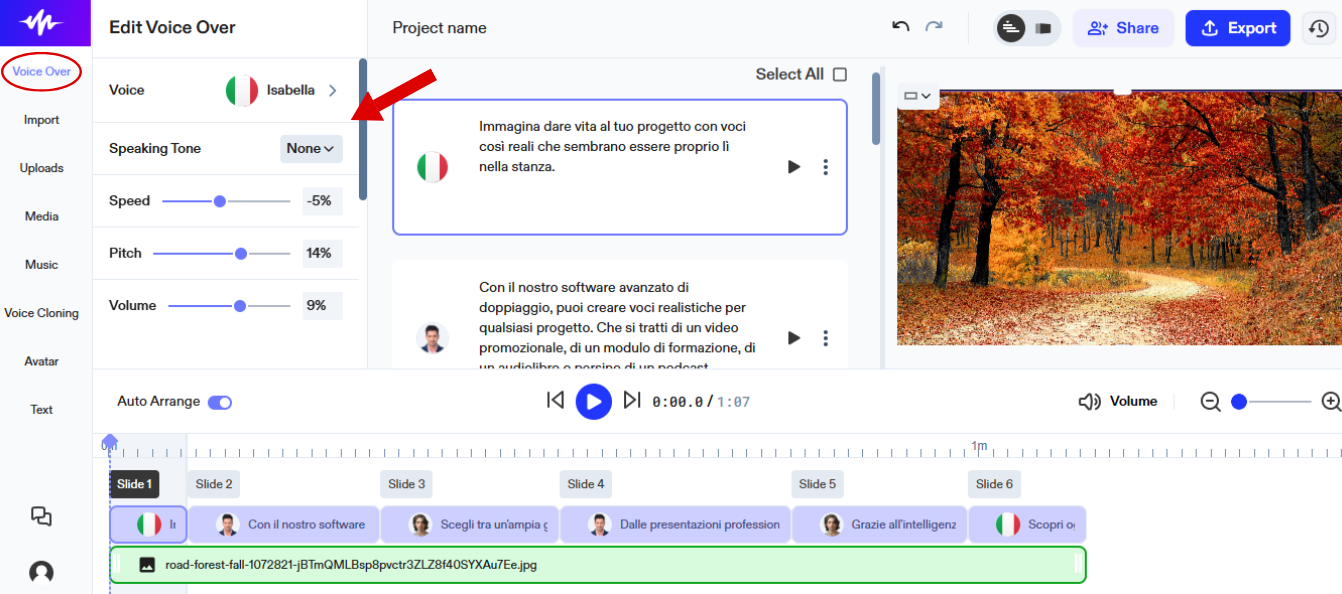
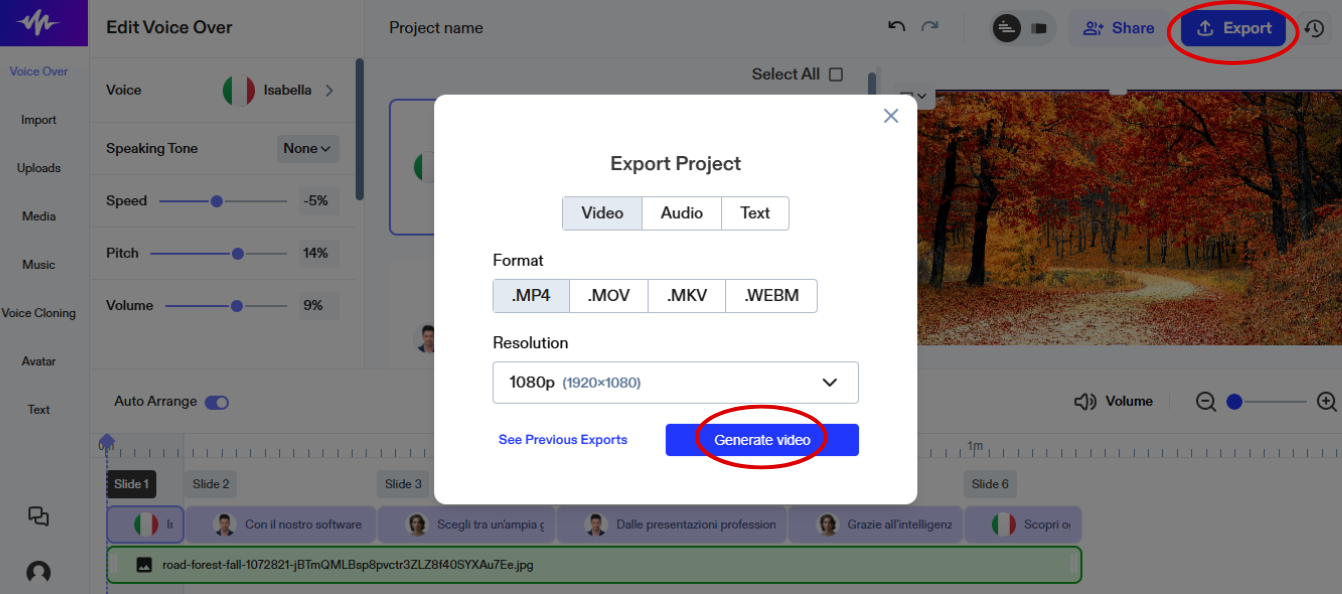
Export your project: When ready, click "Export" and choose your preferred format, such as WAV or MP3.
How to Use Speechify Studio’s Italian Voice Cloning
Creating a custom Italian AI voice clone is straightforward in Speechify Studio. Here’s how to create a unique voice based on your own voice:
Launch a new project: Open Speechify Studio and select "New Project." Select “VoiceOver” from the options to access voice features.
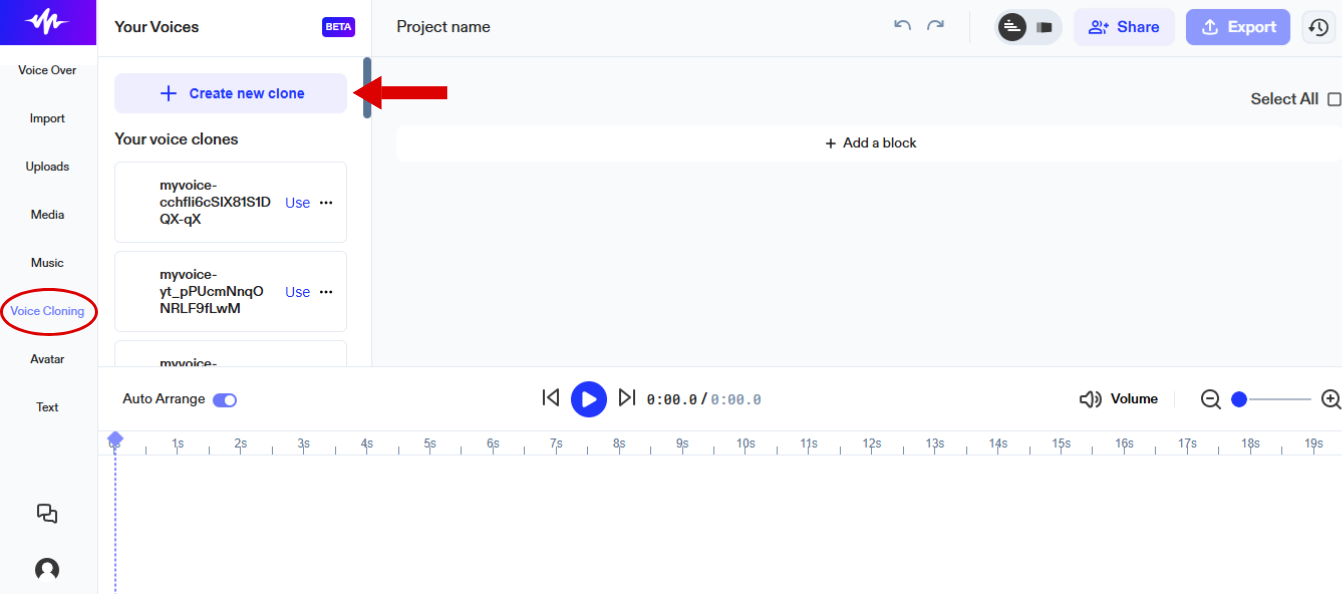
Start voice cloning: Click on "Voice Cloning" and select “Create New Voice Clone.”
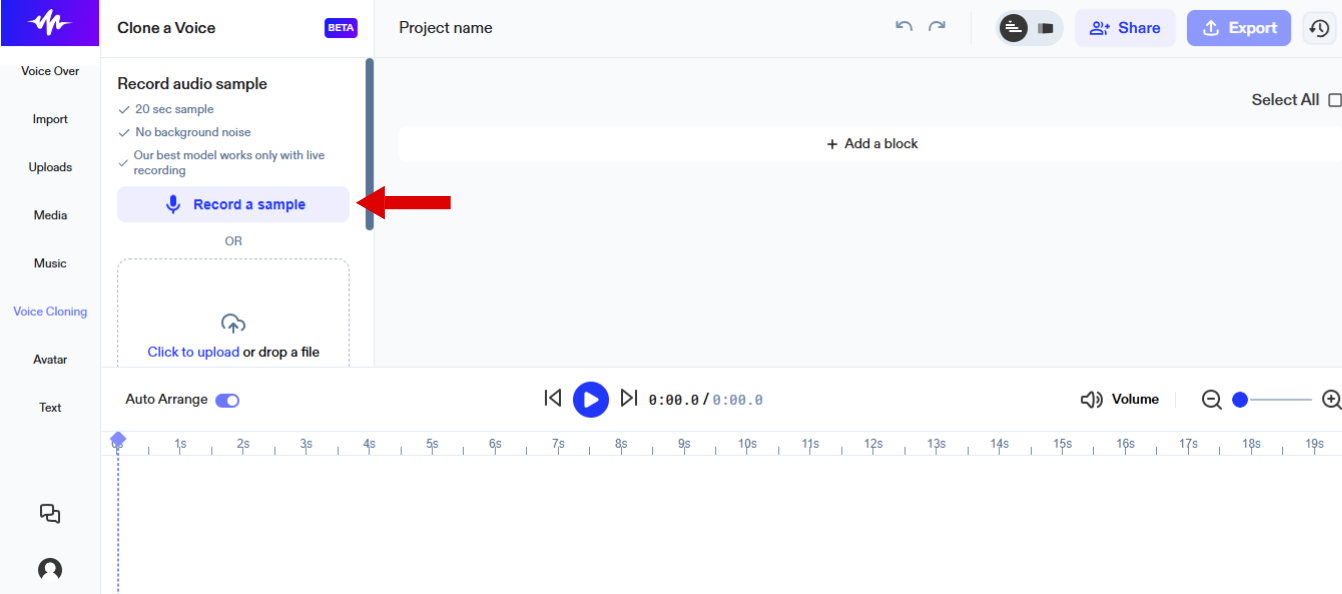
Record a sample: Record a 20-second audio sample of yourself speaking Italian in a quiet setting for optimal accuracy. A live recording is recommended over uploading an existing file.
Generate your voice clone: Press “Continue,” and Speechify Studio will process and generate your unique Italian AI voice clone, which will then be available for all your future projects.
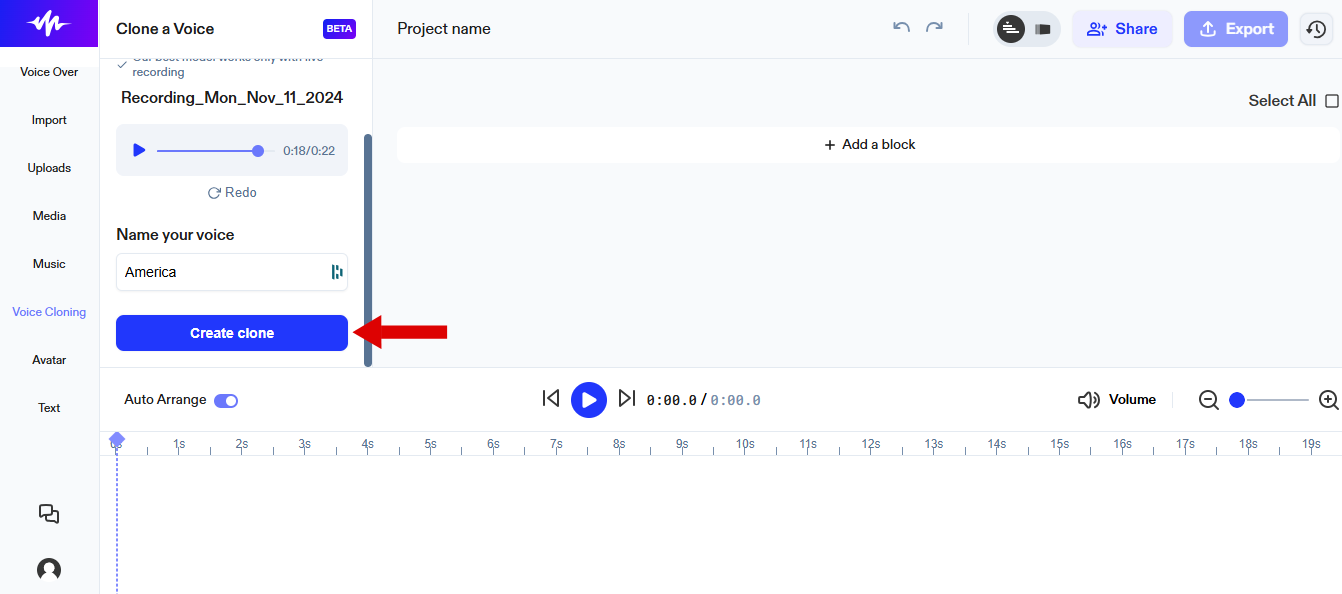
Use your voice clone: To apply your voice clone, follow the same steps as with any standard AI TTS voice. Upload your script and media, select your clone, and Speechify Studio will produce an Italian voice over that sounds just like you.
Most Popular AI Voice Generators for Italian
As Italian content continues to gain popularity, finding the best AI voice generator is key to achieving natural, high-quality results. While Speechify Studio is the overall best Italian AI voice generator, here’s a look at some of the leading Italian AI voice generators, each with its own specialized features to enhance your projects.
Speechify Studio
With over 200 AI voices in 150 languages, Speechify Studio is highly versatile and user-friendly. Its voice cloning feature and AI video editor offer precise control over pitch, tone, and pronunciation, supporting dubbing for Italian projects. Automatic filler-word removal ensures smooth audio, and its API integration makes it adaptable for various applications. A library of stock footage and AI avatars adds visual depth, ideal for professional Italian content creation.
Play.ht
Play.ht supports 142 languages, with high-quality Italian voices and tools for phonetic adjustments to refine flow and clarity. Voice cloning, emotion control, and multi-language support enable authentic, region-specific Italian voice overs tailored to diverse audiences. It’s perfect for creators seeking flexible, lifelike Italian audio in various media.
ElevenLabs
Known for rapid, high-fidelity voice cloning, ElevenLabs is ideal for real-time or fast-paced projects. Its Italian voices are suited to applications needing immediate audio, like live-streaming, without sacrificing quality or naturalness. This efficiency makes it popular for businesses and creators needing quick, realistic Italian voice content.
Descript
Descript’s text-based audio editing simplifies podcast production by allowing users to edit audio via transcript adjustments. For Italian projects, this feature provides precise control over dialogue and structure. With multi-language support, filler word removal, and broadcast-quality output, Descript is valuable for professional creators seeking polished, platform-ready Italian content.
LOVO
LOVO offers 500+ voices, including expressive Italian options with customizable pronunciation, tone, and emotion. Known for storytelling and brand narration, it supports character-driven content and consistent voice quality across projects. LOVO’s advanced voice cloning enables dynamic Italian voice overs that engage listeners through an authentic experience.
Listnr
Listnr’s library of 900 voices in 142 languages includes top-tier Italian voices and robust tools like voice cloning and seamless editing. Especially useful for podcasts, it simplifies production from recording to publishing. The platform’s lifelike Italian voices allow creators to produce compelling audio that resonates with French-speaking audiences across industries.
Murf.ai
Murf offers intuitive controls for creating conversational, engaging Italian voice overs, with options for adjusting pauses, breaths, and pronunciation. Its voice cloning keeps a consistent tone across projects, ideal for creators producing high-quality, relatable Italian content that feels naturally tailored to listeners.
NaturalReader
NaturalReader supports 27 languages with over 200 voices, including Italian. Its pronunciation, pitch, and emphasis adjustments make it versatile for storytelling, educational, and promotional content. With emotional customization, Italian voice overs feel expressive, enhancing narratives for a compelling listening experience.
Synthesys
With 370+ voices across 140 languages, Synthesys provides high-quality, scalable Italian voice overs. Its unlimited downloads feature is great for brands managing large projects, offering Italian voices that maintain engagement in settings like advertising, training, and corporate presentations.
WellSaid Labs
WellSaid Labs’ real-time editing tools across 50 voices provide precise control over Italian voice production. Its nuanced editing is ideal for high-grade Italian audio in industries like broadcasting, training, and customer support, ensuring clarity and authenticity in professional audio.
Respeecher
Respeecher’s advanced voice cloning captures the subtleties of natural speech, ideal for realistic Italian dubbing in film, gaming, and audio dramas. Its detailed voice replication creates immersive Italian experiences suited to audiences seeking high-quality audio fidelity.
Synthesia
Synthesia combines TTS with AI avatars, offering a fully immersive experience for Italian video content. It’s highly valuable for interactive marketing and education, with Italian voice cloning and customizable avatars adding a personal touch to create a rich learning or viewing experience.
Resemble AI
With tools like voice cloning, emotion control, and voice changers, Resemble AI produces nuanced Italian audio. Its strong emotion control allows creators to deliver expressive Italian voice overs, perfect for content needing an emotional connection, such as ads, audiobooks, and interactive media.
Clipchamp
Clipchamp’s 170 voices in 80 languages include unique tools for Italian audio creation, like automatic captioning and a speaking coach. These features support Italian language learning and presentations, enabling clear, authentic Italian-speaking skills in content for greater engagement.
Narakeet
Narakeet offers 600 voices across 90 languages, with options for Italian accents. Integrating with Amazon Polly and Microsoft, it’s ideal for educational or presentation-based content. Narakeet’s ability to match accents ensures Italian audio suited to diverse Italian-speaking audiences’ preferences.
VEED
VEED offers auto-subtitle, translation, and audio tools in 50+ languages, including Italian. Its tone and speed adjustments support well-paced, clear Italian voice overs for content creators. Accurate Italian audio with minimal editing makes VEED effective for instructional videos, social media, and corporate presentations.
Conclusion
With advancements in AI technology, Italian voice generation has become an essential tool for reaching Italian-speaking audiences authentically. From lifelike Italian TTS voices to personalized voice cloning, tools like Speechify Studio provide remarkable flexibility and accuracy for content creation. By enabling region-specific accents and nuanced language adjustments, these AI voice generators make it easier than ever for brands, educators, and content creators to produce high-quality Italian voice overs that resonate with listeners.
FAQ
What is Italian text to speech?
Italian text to speech is a technology that converts Italian text into spoken audio, and Speechify Studio offers a natural and accurate experience.
How do I convert Italian text to speech?
Simply upload or type your Italian text into Speechify Studio, select an Italian voice, and generate your audio instantly.
Which AI voice generator offers the best Italian pronunciation?
Speechify Studio’s AI voice generator provides top-tier Italian pronunciation, delivering authentic, lifelike voices that capture regional nuances.
What is the text to speech app for Italian?
Speechify Studio is the best app for Italian text to speech since it offers the most lifelike Italian AI voices, perfect for creating polished audio for various needs.
What is the best Italian AI text to speech generator?
Speechify Studio stands out as the best Italian AI text to speech generator, combining quality, realism, and customization.
Is there a free Italian AI voice generator?
Yes, Speechify Studio offers a free Italian text to speech generator so you can try its Italian AI voice capabilities without subscribing to its premium pricing plans.