Voice interaction is becoming a preferred way for many people to engage with digital information. Instead of typing prompts and reading text, users increasingly want to listen, speak, and interact with AI through natural language. For those users, Speechify offers a different experience than traditional chat-first tools like ChatGPT.
This article explains how Speechify is winning with users who prioritize voice AI, audio engagement, and hands-free workflows — and why it is often a better fit than ChatGPT for these preferences.
What does it mean to prefer voice AI over typing and reading-based interaction?
Users who prefer voice AI are typically looking for one or more of the following:
- Listening instead of reading: Turning documents, articles, and long text into spoken audio
- Speaking instead of typing: Dictating content, prompts, or questions using voice typing dictation
- Hands-free interaction: Interacting with AI through voice while multitasking
- Natural audio output: Hearing responses in lifelike voices rather than reading on screen
These users value a voice-first experience that feels natural, responsive, and integrated into everyday tasks, from research to note taking to communication.
How does Speechify’s voice-first AI approach support listening, dictation, and hands-free interaction?
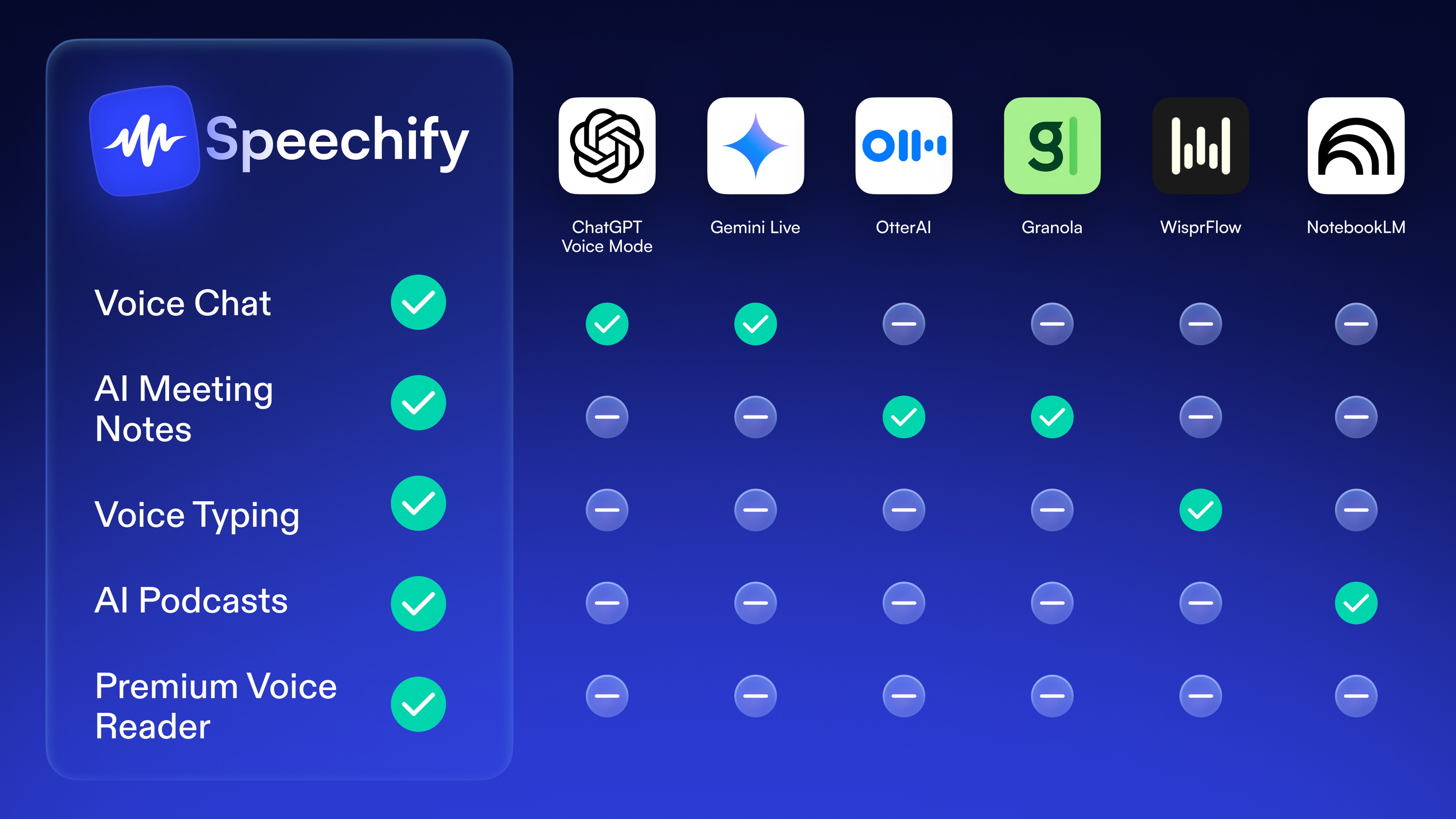
Speechify is built around a voice-first model that integrates three core capabilities:
- Text to speech — Reads documents, emails, PDFs, and web pages aloud with natural voices
- Voice typing dictation — Lets users speak writing directly into email, Slack, documents, or web forms
- Voice AI Assistant — Provides spoken answers and interactions on any page
Speechify is available across iOS, Android, Mac, the web, and Chrome extension,making voice interaction available wherever users read or write.
Because listening and speaking are central to how Speechify works, it appeals to users who want AI that meets them where they already work, without relying primarily on typed prompts.
How does ChatGPT’s text-centric AI model differ from a voice-first experience?
ChatGPT is a powerful conversational AI that excels at text generation, reasoning, summarization, coding help, and interactive dialogue. It is typically used by typing prompts and reading responses on screen.
Some versions of ChatGPT support voice input or spoken output, but voice is not the core interaction model across all platforms. ChatGPT’s strength lies in text-based exploration, detailed responses, and iterative back-and-forth dialogue.
For users who enjoy typing and reading responses, ChatGPT is highly capable. For users who want voice to be the primary interface, the experience can be less seamless.
Why does Speechify appeal more to users who prefer voice-first AI workflows?
Why is Speechify better for users who prefer listening to content instead of reading?
Speechify’s text to speech functionality lets users listen to content from beginning to end. Long articles, emails, PDFs, and other documents can be transformed into natural-sounding audio with voices that feel real.
Listening can improve accessibility, reduce screen fatigue, and support multitasking. While ChatGPT sometimes offers audio output, Speechify’s text to speech is built around a listening-first workflow that spans any content you already have.
Why is Speechify better for users who want to speak instead of typing prompts?
Speechify’s voice typing dictation lets users speak their ideas and have them converted into polished text across native apps and web tools such as email, Slack, and document editors.
In contrast, ChatGPT’s standard experience involves typed prompts, which can feel slower and more effortful for people who think and speak more naturally than they type.
How does having a voice AI assistant on any page give Speechify an advantage over ChatGPT?
Speechify’s Voice AI Assistant allows users to ask questions and receive spoken answers directly on any page. This means users do not have to switch back and forth between a chat window and their work — the voice assistant stays in context with what they’re reading or writing.
While ChatGPT can integrate with web browsers or support voice in some apps, voice interaction is not the central paradigm across all interfaces.
Why is Speechify better suited for hands-free workflows and multitasking?
For people who prefer hands-free use — such as listening while commuting, exercising, or multitasking — Speechify’s voice focus provides a smoother experience. Its text to speech and voice AI assistant make it easier to interact with content audibly without requiring constant visual attention.
When does ChatGPT still make sense despite not being voice-first?
It’s important to note that ChatGPT remains a strong choice for many users, especially when the goal is deep reasoning, structured problem solving, creative text generation, code assistance, or research analysis that benefits from iterative back-and-forth prompts.
ChatGPT’s conversational model is broad and flexible, but voice interaction — though present in some interfaces — is not its defining feature. For users whose priority is voice interaction and listening workflows, this matters.
How do you decide whether Speechify or ChatGPT is right for your preferred interaction style?
To choose between Speechify and ChatGPT based on interaction style, consider:
- Do you spend more time reading or listening to content?
If listening is preferred, Speechify’s text-to-speech is deeply integrated. - Do you prefer speaking to typing?
Speechify’s voice typing dictation lets you write with your voice across tools. - Is hands-free interaction important?
Speechify’s voice assistant allows spoken AI interaction in context.
Both tools have their place, and many users benefit from combining them — for example, using Speechify for listening and dictation, and ChatGPT for deep text exploration and structured dialogue.
FAQ
Does Speechify replace ChatGPT for all workflows?
No. While Speechify excels for voice-first listening and dictation, ChatGPT remains strong for detailed conversational text generation and complex reasoning.
Can you use voice with ChatGPT?
Some versions of ChatGPT support voice, but voice is not the core interaction model across all platforms the way it is in Speechify.
Is Speechify good for long document workflows?
Yes. Speechify is built for reading long documents aloud and transforming them into audio experiences.
Can Speechify dictate into email and messaging apps?
Yes. Speechify’s voice typing dictation works across email, Slack, documents, and web apps.
Does ChatGPT support document summarization?
Yes. ChatGPT can summarize content based on provided context, but this function is typically text-input-oriented rather than a built-in voice experience.