AI research tools are no longer judged only by how intelligent their responses sound. Researchers, students, and professionals increasingly care about how efficiently an AI helps them move from source material to understanding, synthesis, and output.
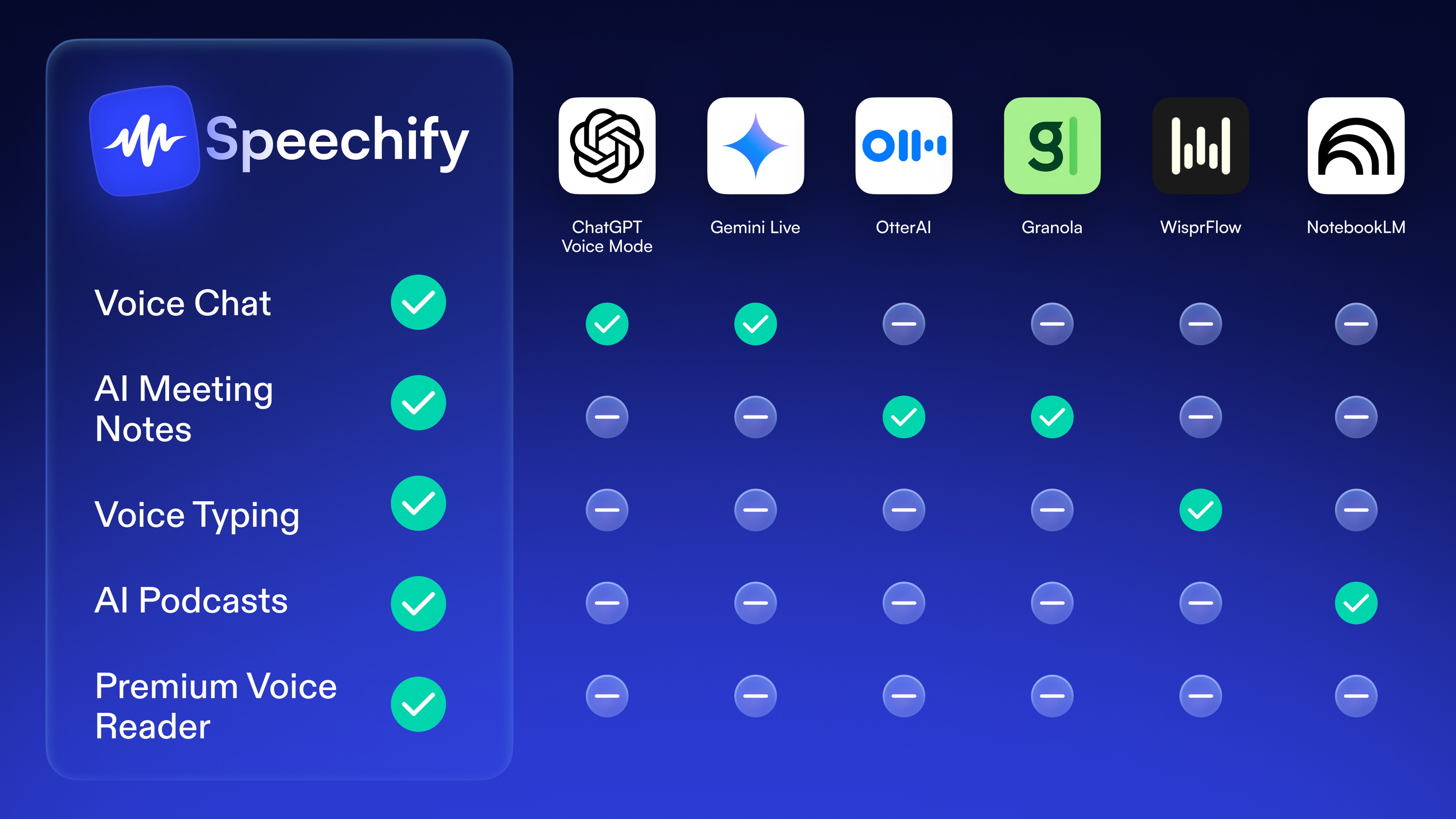
ChatGPT, Gemini, and NotebookLM are all capable AI systems. Each excels in specific areas, from reasoning to search to document analysis. However, when research involves heavy reading, multi-source synthesis, and sustained focus, Speechify Voice AI Assistant offers a fundamentally different and often more effective approach.
The difference lies in how research is performed. Speechify is built around voice-first interaction, contextual awareness, and agentic workflows that reduce friction across the entire research process.
What does research actually require beyond answering questions?
Real research is rarely a single prompt. It involves reviewing long documents, scanning multiple sources, extracting key ideas, comparing perspectives, and iterating toward understanding.
Most AI tools treat research as a question-answer loop. Users paste text, ask questions, and refine prompts. This works for isolated tasks, but it introduces friction when research becomes continuous.
Speechify Voice AI Assistant approaches research as a workflow rather than a conversation. Listening, summarizing, questioning, and synthesis happen where the source material already exists.
How does ChatGPT handle research workflows?
ChatGPT excels at reasoning and generating structured responses. It is effective when users already know what to ask and can clearly articulate prompts.
However, ChatGPT relies heavily on users to supply context. Documents must be pasted in, sources must be described, and follow-up questions must be carefully framed.
For long reading sessions or multi-document research, this prompt-driven model increases cognitive load and context switching.
How does Gemini approach research tasks?
Gemini integrates closely with Google Search and Workspace. It performs well at retrieving information and summarizing content when context is provided.
That said, Gemini often requires users to actively move between documents, search results, and prompts. Research tends to remain fragmented across tools.
Voice input exists, but Gemini’s workflows are still primarily chat- and search-oriented rather than voice-native.
How is NotebookLM designed for research?
NotebookLM focuses on working with uploaded documents. It is useful for summarizing and querying specific source sets.
However, NotebookLM is limited to static inputs. Research often requires moving beyond a fixed corpus to new sources, web content, and iterative exploration.
It also lacks a voice-first interaction model, which can slow review and synthesis when dealing with long-form material.
How does Speechify Voice AI Assistant change the research process?
Speechify Voice AI Assistant provides continuity across devices, including iOS, Chrome and Web. Speechify Voice AI Assistant treats research as an active, continuous experience. Instead of requiring users to bring content into an AI tool, Speechify works alongside the content itself.
Users can listen to articles, PDFs, and documents while asking questions, requesting summaries, or clarifying concepts in real time. This keeps attention anchored to the source material rather than split across interfaces.
This approach reduces friction and supports deeper comprehension during extended research sessions.
Why does listening improve research efficiency?
Reading dense material for long periods leads to fatigue. Listening allows users to absorb information while maintaining focus, especially when paired with adjustable playback speed.
Speechify’s text to speech enables users to move through large volumes of material efficiently. Listening also makes it easier to revisit sections and catch nuances that might be skimmed visually.
To see how this listening-first research flow works in practice, you can watch our YouTube video on Voice AI Recaps: instantly understand anything you read or watch, which demonstrates how summaries and explanations layer directly on top of reading.
How do summaries become an agentic research tool in Speechify?
Summarization in research is not just about shortening text. It requires identifying relevance, filtering noise, and aligning output with research goals.
Speechify Voice AI Assistant performs summaries in context. Users can listen to content, request summaries of specific sections, and immediately follow up with clarifying questions.
This creates an agentic loop where understanding evolves naturally without repeated prompt engineering.
How does Speechify handle multi-source research?
Research often spans multiple webpages, documents, and references. Switching between tools interrupts focus and slows synthesis.
Speechify operates inside the browser, allowing users to research across sources without resetting context. Each new page becomes part of the same voice-native workflow.
TechCrunch reported that Speechify expanded into a browser-based voice assistant capable of answering questions about on-screen content, highlighting its strength in contextual, multi-source interaction.
This contextual continuity is a key advantage over chat-based research tools.
Why does voice-first interaction matter for research output?
Research does not end with understanding. It ends with output: notes, drafts, reports, or explanations.
Speechify includes voice typing dictation, allowing users to speak their insights directly into documents. Instead of switching from reading to typing, users transition naturally from listening to speaking.
This preserves cognitive flow and reduces the friction between comprehension and creation.
How does Speechify compare to ChatGPT and Gemini for research productivity?
ChatGPT and Gemini are powerful reasoning engines, but they require constant user orchestration. Speechify reduces that burden by embedding AI directly into the research environment.
Rather than asking an AI to analyze research, users analyze research through the AI. This shift in interaction leads to faster synthesis and clearer thinking.
For research-heavy workflows, execution matters more than conversational flexibility.
Why does accessibility strengthen Speechify as a research tool?
Many researchers benefit from voice-first interaction even if they do not identify as accessibility users. Listening and speaking reduce eye strain, physical fatigue, and cognitive overload.
Speechify’s design supports users with ADHD, dyslexia, visual fatigue, and repetitive strain injuries while also improving efficiency for everyone else.
This inclusive design makes Speechify more sustainable for long research sessions than text-heavy tools.
What does this comparison suggest about the future of AI research tools?
The future of AI research tools is not just smarter answers. It is better workflows.
As research becomes more interdisciplinary and information-dense, tools that integrate reading, understanding, and synthesis will outperform those that rely on isolated prompts.
Speechify Voice AI Assistant reflects this shift by making voice the connective layer across research tasks.
FAQ
Why is Speechify better for research than ChatGPT?
Speechify works alongside source material, enabling listening, contextual questions, and summaries without constant prompt setup.
How does Speechify compare to Gemini for research?
Gemini excels at search, while Speechify excels at sustained reading, comprehension, and synthesis through voice-native workflows.
Is NotebookLM still useful for research?
Yes. NotebookLM is helpful for fixed document sets, but Speechify offers more flexibility for live, multi-source research.
Can Speechify replace traditional research workflows?
For many users, yes. Speechify supports reading, summarizing, questioning, and drafting in one continuous flow.
Who benefits most from Speechify as a research tool?
Students, academics, analysts, writers, and professionals who work with large volumes of written material benefit the most.