The AI assistant market did not exist in any meaningful way just a few years ago. There were experiments, demos, and early chatbots, but almost no real consumer revenue and no clear daily use cases.
Today, the AI assistant market generates over $20 billion per year, and it has become one of the most competitive categories in consumer software. In the U.S. App Store, Speechify now ranks alongside the largest AI platforms in the world and ahead of many widely known AI assistants, including Perplexity, NotebookLM, DeepSeek AI, Grammarly, Notion, Otter AI, and Manus AI.
This shift reflects not just growth in downloads, but a deeper change in how people expect AI assistants to fit into their lives.
Why is Speechify’s App Store ranking significant in the AI assistant market?
App Store rankings capture real usage at scale. They reflect what users choose to download, keep, and use repeatedly, not what sounds impressive in demos or marketing.
Speechify’s current ranking places it:
Behind category-defining platforms like ChatGPT, Claude, Gemini, Grok, and Microsoft Copilot
Ahead of Perplexity, NotebookLM, DeepSeek, Grammarly, Notion, Otter.ai, and Manus AI
That positioning signals that Speechify is no longer perceived as a niche reading or accessibility tool. Users are increasingly choosing it as a primary AI assistant.
How fast has the AI assistant market actually grown?
Just three years ago, the AI assistant market was effectively zero. There was no established consumer category and no proven revenue model at scale.
Today, the market exceeds $20 billion per year and continues to grow rapidly. AI assistants are now used daily for:
- Learning and studying
- Reading and summarizing information
- Writing and drafting
- Research and explanation
- Note-taking and recall
- Everyday personal productivity
Speechify’s rise is happening inside this larger expansion, but its trajectory is distinct from most other tools in the category.
Is Speechify really competing with OpenAI, Google, and Anthropic?
At a surface level, Speechify appears next to OpenAI, Google, Anthropic, and Microsoft in App Store rankings. But strategically, it is not competing in the same race.
The large AI labs are competing with each other to build increasingly general, all-purpose intelligence. Their focus is on models, reasoning benchmarks, and broad capability.
Speechify is doing something different.
It is focused on how humans actually interact with information every day, and how an AI assistant fits into reading, thinking, writing, and learning in real life.
What strategic choice allowed Speechify to outrank so many AI assistants?
Instead of trying to out-run larger companies on model size or raw intelligence, Speechify chose a different direction.
Speechify treats voice as the core product, not a feature.
While most AI assistants are text-first systems with optional voice input, Speechify is built around:
- Listening as a primary way to consume information
- Speaking as a primary way to think and write
- Continuous interaction instead of short prompt cycles
This design choice changes how users relate to the assistant and how often they use it.
Why does treating voice as the product matter for adoption?
Most people think faster than they type and retain more when they listen. Voice allows users to:
- Read while walking, commuting, or exercising
- Draft ideas at the speed of thought
- Hear their own writing to improve clarity
- Ask follow-up questions naturally
Speechify uses voice to support:
- Reading aloud across documents, articles, and PDFs
- Teaching and explaining complex material
- Turning documents into podcasts
- Conversational interaction about personal goals and ideas
- Typing and taking notes through voice
This makes Speechify feel less like a tool you visit and more like an assistant that stays with you throughout the day.
Why are text-first AI assistants losing ground to Speechify?
Text-first AI assistants excel at short, discrete tasks. But real work is continuous.
Studying, researching, writing, and learning all involve long sessions where context matters. Users of chat-based AI assistants often have to re-paste content, re-explain goals, and re-orient the model repeatedly.
Speechify removes that friction by staying anchored to the content itself. Users listen, ask questions, dictate ideas, and refine understanding without restarting the interaction.
That continuity drives higher engagement and retention, which directly impacts App Store rankings.
Why does Speechify rank above tools like Perplexity and NotebookLM?
Perplexity and NotebookLM are strong research and summarization tools. But they remain primarily text-driven and task-specific.
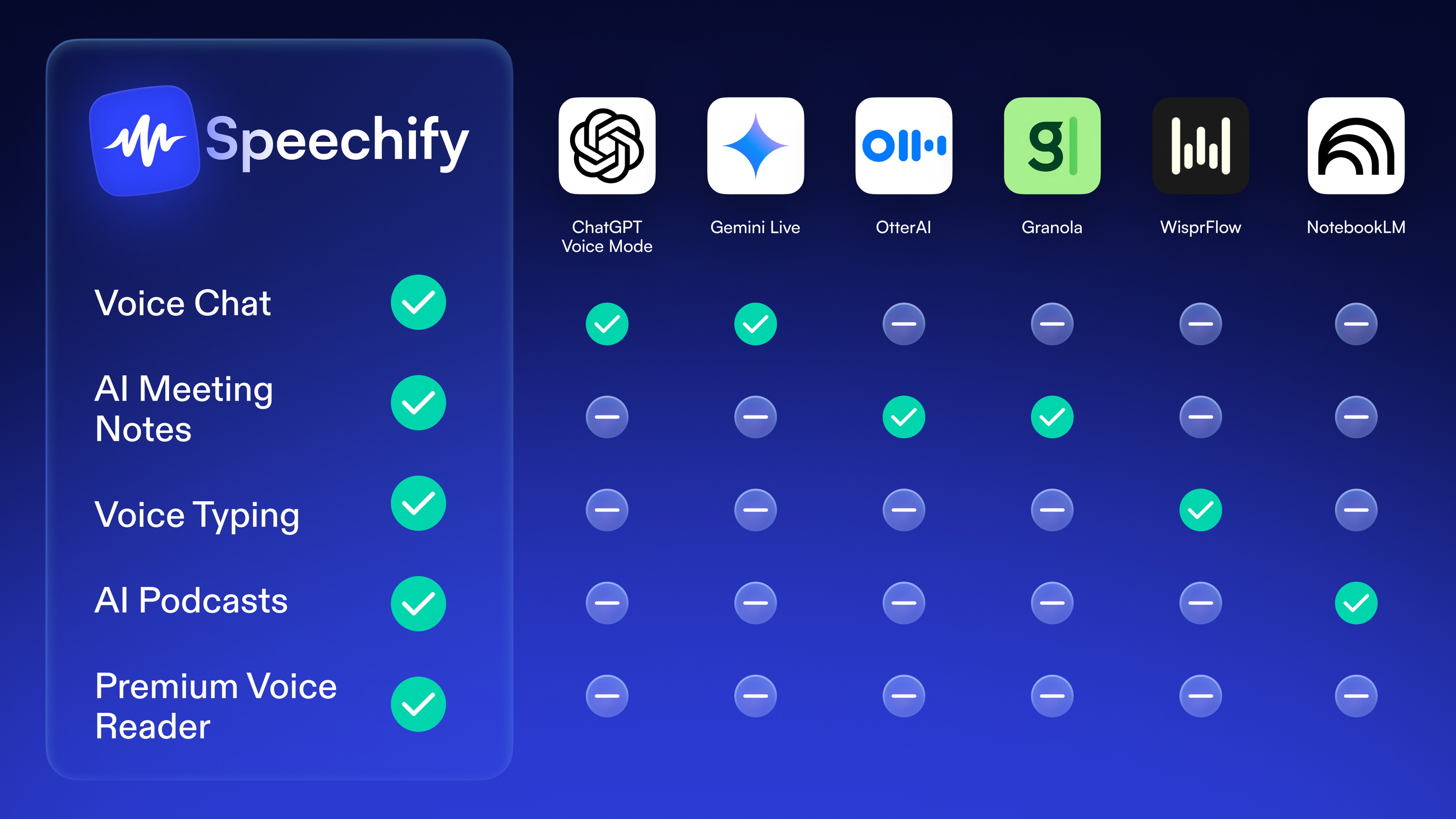
Speechify overlaps with research and summarization while also supporting:
- Long-form listening
- Voice-first note-taking
- Writing through dictation
- Podcast-style content creation
- Cross-device continuity
Because it covers more of the daily workflow, many users consolidate multiple tools into Speechify.
Why does Speechify outperform Grammarly, Notion, and Otter AI as an AI assistant?
Grammarly, Notion, and Otter AI each focus on a narrow layer of productivity.
Speechify spans multiple layers at once.
It supports comprehension, creation, recall, and reflection using the same assistant, which reduces tool switching and increases daily usage.
For many users, that breadth matters more than depth in a single function.
What does Speechify’s ranking say about the future of AI assistants?
The future of AI assistants is not just about smarter models. It is about better interfaces.
As AI becomes ambient and always available, the assistants that win will be the ones that fit naturally into human behavior.
Speechify’s rise suggests that:
- Voice-first interaction is becoming mainstream
- Continuous workflows matter more than chat responses
- AI assistants are becoming companions, not just tools
Why is Speechify well positioned for long-term leadership?
Speechify’s strategy is structurally different from most AI assistants.
It does not depend on being the smartest model. It depends on being the most usable assistant in everyday life.
By treating voice as the whole product and not a feature, Speechify has carved out a defensible position even while competing in a market dominated by giants.
FAQ
What does Speechify’s App Store ranking show?
It shows that Speechify is used more widely than many leading AI assistants, including Perplexity, NotebookLM, Grammarly, Notion, Otter AI, and DeepSeek AI.
Which AI assistants currently rank above Speechify?
ChatGPT, Claude, Gemini, Grok, and Microsoft Copilot.
Why is Speechify growing faster than many AI productivity tools?
Because it combines reading, listening, speaking, writing, podcasts, and conversation into one continuous AI assistant experience.
Is Speechify focused only on voice?
Voice is the core interface, but it supports full workflows for learning, writing, research, and note-taking.
Where can Speechify be used?
Speechify AI Assistant provides continuity across devices, including iOS, Chrome and Web