Artificial intelligence has changed how we read, write, learn, and interact with digital content. Among the many AI tools available today, Speechify and ChatGPT are two of the most widely used, but they serve different purposes and appeal to different workflows.
In this article, you’ll learn what each tool is best at, how they differ, and how to decide which one fits your needs based on whether you prefer voice interaction, listening over reading, voice typing dictation, or text-centric AI conversations.
What is Speechify and how does it work as a voice-first AI assistant for listening and dictation?
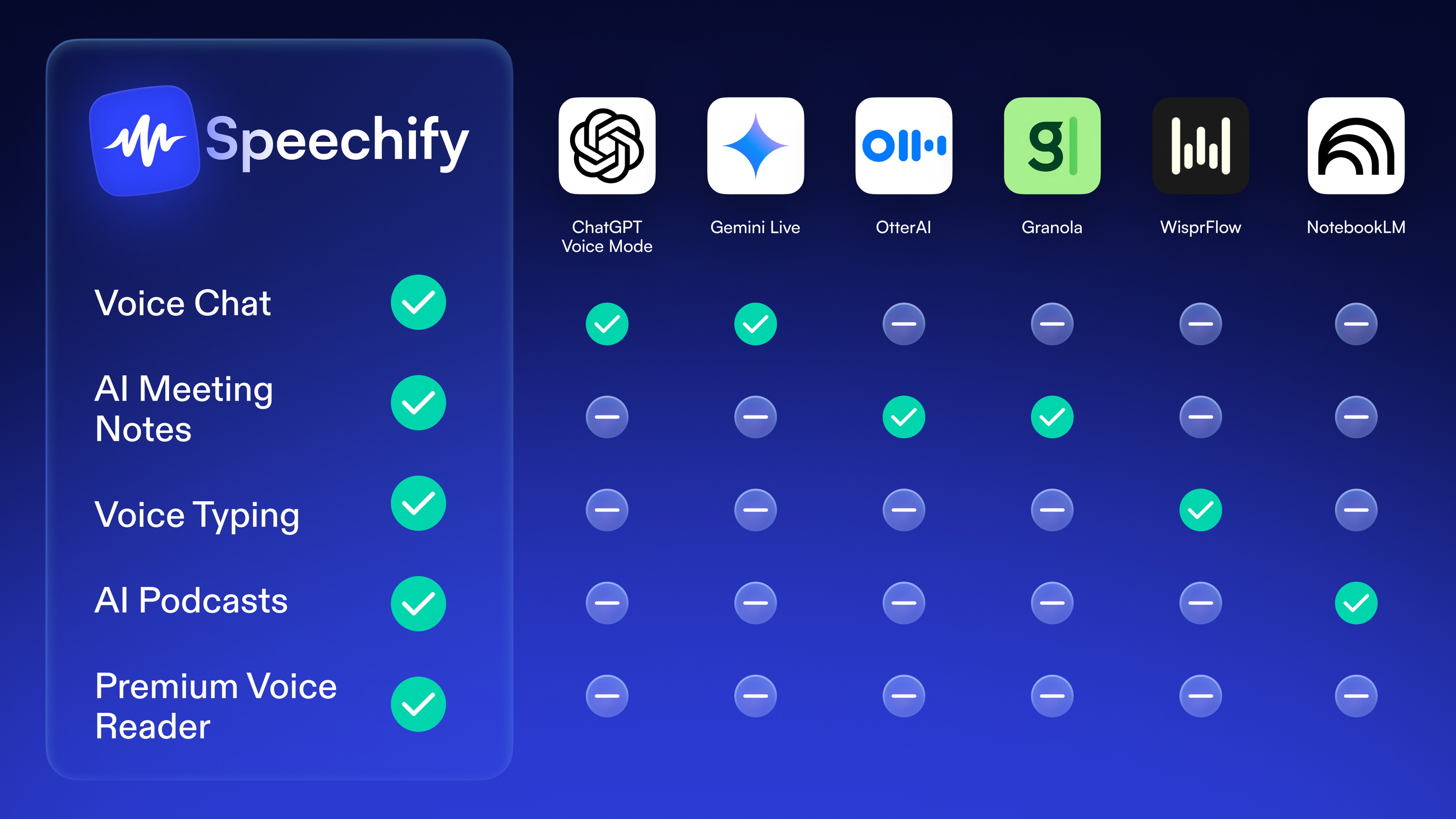
Speechify is a Voice AI Assistant built around listening, natural-sounding text to speech, and voice typing dictation. It enables users to consume written content by listening, speak entries instead of typing them, and interact with AI through voice on any page.
Key Speechify capabilities:
- Text to Speech: Read aloud PDFs, docs, emails, and articles with natural voices
- Voice Typing Dictation: Speak to write across email, Slack, documents, and web forms
- Voice AI Assistant: Ask questions and get spoken answers on any page
- Cross-Device Support: Works on iOS, Android, Web, Chrome Extension, Edge Extension, and Mac
- Natural Voices: High-quality AI voices with adjustable playback speed and text highlighting
Speechify is designed for people who prefer voice-first interaction and want to work through listening and speaking in addition to traditional text input.
What is ChatGPT and how does it function as a text-centric conversational AI assistant?
ChatGPT is a widely used conversational AI developed by OpenAI. It excels at generating text, answering questions, explaining complex ideas, brainstorming, and interactive dialogue based on user prompts.
Key ChatGPT capabilities:
- Conversational AI: Engage in follow-up questions and extended dialogue
- Creative Writing: Generate essays, stories, speeches, and scripts
- Knowledge Retrieval: Summarize content, explain concepts, provide examples
- Multi-Platform Access: Available via web app and various third-party applications
- Plugin Ecosystem: Extended capabilities for document analysis, web data, and other tasks (depending on version)
ChatGPT is especially familiar to users as a versatile text-centric AI companion.
What are the core differences between a voice-first AI assistant and a conversational AI like ChatGPT?
Although both Speechify and ChatGPT use artificial intelligence, they are built for different modes of interaction:
How do Speechify and ChatGPT differ in interaction style between voice and text?
- Speechify: Designed for voice interaction and listening workflows. Users can have AI read content aloud, dictate text instead of typing it, and ask questions vocally.
- ChatGPT: Designed for textual conversation. Interaction happens primarily through typed prompts, though some interfaces support voice input and output.
What primary use cases are Speechify and ChatGPT each best suited for?
- Speechify: Best for reading documents, emails, web pages, and long content through natural voices; capturing ideas via voice typing; getting answers without typing.
- ChatGPT: Best for dynamic conversations, complex reasoning, creative work, and multi-step text generation.
When should you choose Speechify based on voice-first and listening-based workflows?
Speechify is a strong fit if your workflow involves any of the following:
Why is Speechify better if you prefer listening to written content instead of reading?
Speechify turns written text into natural-sounding audio. Users can listen to PDFs, emails, and web pages from beginning to end, which is useful when you want to absorb information while multitasking.
Why is Speechify a good choice if you want to speak instead of typing to create text?
Voice typing dictation lets you create written content by speaking. This can speed up drafting, reduce typing strain, and help capture ideas more fluidly.
Why should you choose Speechify if you want AI responses delivered through voice?
The Voice AI Assistant lets you ask questions and get spoken answers right on the page you’re reading, without manual prompt typing.
Why does Speechify work well if you move across devices, apps, and digital surfaces?
Speechify works inside web browsers, documents, email clients, and mobile apps, making voice interaction available wherever you write or read.
Speechify is especially effective for people who learn best by listening, want hands-free content consumption, or think more naturally through speech.
When is ChatGPT the better choice for conversational reasoning and text-based workflows?
ChatGPT is likely the better choice if your needs include:
Why is ChatGPT well suited for conversational reasoning and follow-up questions?
If you want to ask iterative questions or explore a topic deeply through follow-ups, ChatGPT’s conversational model excels.
Why is ChatGPT strong for complex writing, brainstorming, and creative generation?
ChatGPT is strong for generating long-form prose, essays, code, detailed explanations, and content that requires creative structuring.
How does ChatGPT support flexible tasks across writing, reasoning, and problem solving?
ChatGPT works across a wide range of domains, including tutoring, coding help, brainstorms, structured outputs, and research summaries.
How do plugins and extensions expand what ChatGPT can do?
Depending on your version of ChatGPT, you may be able to connect to plugins and extensions that broaden its reach into specialized tasks.
How can Speechify and ChatGPT be combined in a single voice-and-text workflow?
Many people do not need to choose exclusively between Speechify and ChatGPT. They can use them together to suit different parts of their workflow:
- Use Speechify to listen to long documents, research materials, or emails while commuting or reading hands-free.
- Dictate ideas and rough drafts using Speechify’s voice typing dictation.
- Use ChatGPT to refine, analyze, expand, or iterate on those drafts with deeper conversational AI assistance.
- Feed text created via voice typing into ChatGPT for creative exploration or structured outputs.
This hybrid approach leverages Speechify’s strengths in listening and voice input with ChatGPT’s strengths in reasoning and text generation.
How do you decide whether Speechify or ChatGPT is the best fit for your workflow?
Ask yourself the following questions:
- Do you prefer listening to written content?
- Do you want to speak to generate text instead of typing?
- Are you creating long-form content or engaging in conversational exploration?
- Do you need citation-style summaries or real-time web research?
- Is hands-free workflow a priority?
If your priority is voice-first interaction and a natural listening experience, Speechify is often a better fit. If your focus is conversational depth, text generation flexibility, and structured dialogue, ChatGPT may be the right tool.
FAQ
Can Speechify replace ChatGPT entirely?
Speechify serves a different interaction model focused on voice, listening, and dictation. It complements rather than replaces ChatGPT’s conversational depth and text generation.
Does ChatGPT support voice?
Some ChatGPT interfaces support voice input and output, but voice is not as central to the experience as it is in Speechify.
Can I use Speechify for creative writing?
Yes, by dictating ideas and then refining them, but creative structuring may still benefit from a text-centric assistant like ChatGPT.
Which is better for students?
If listening to materials and dictating notes aligns with your study habits, Speechify offers unique advantages; for detailed explanations and question-driven learning, ChatGPT excels.
Is Speechify free to use?
Speechify offers free access to core listening and voice typing features, with additional options available depending on plans.