NotebookLM is designed as a research assistant that helps users analyze and summarize uploaded sources using Google’s Gemini models. It excels at grounding answers in documents and providing citations tied directly to source material. However, not every workflow revolves around static research notebooks.
Many people want AI tools that work across everyday surfaces, support voice interaction, allow hands-free input, and fit naturally into reading, writing, and thinking workflows. For those users, there are several strong NotebookLM alternatives worth considering.
This article explores the best alternatives to NotebookLM, with a focus on how they differ in interaction style, flexibility, and real-world usability.
How does Speechify work as a voice-first AI assistant for reading, writing, and thinking?
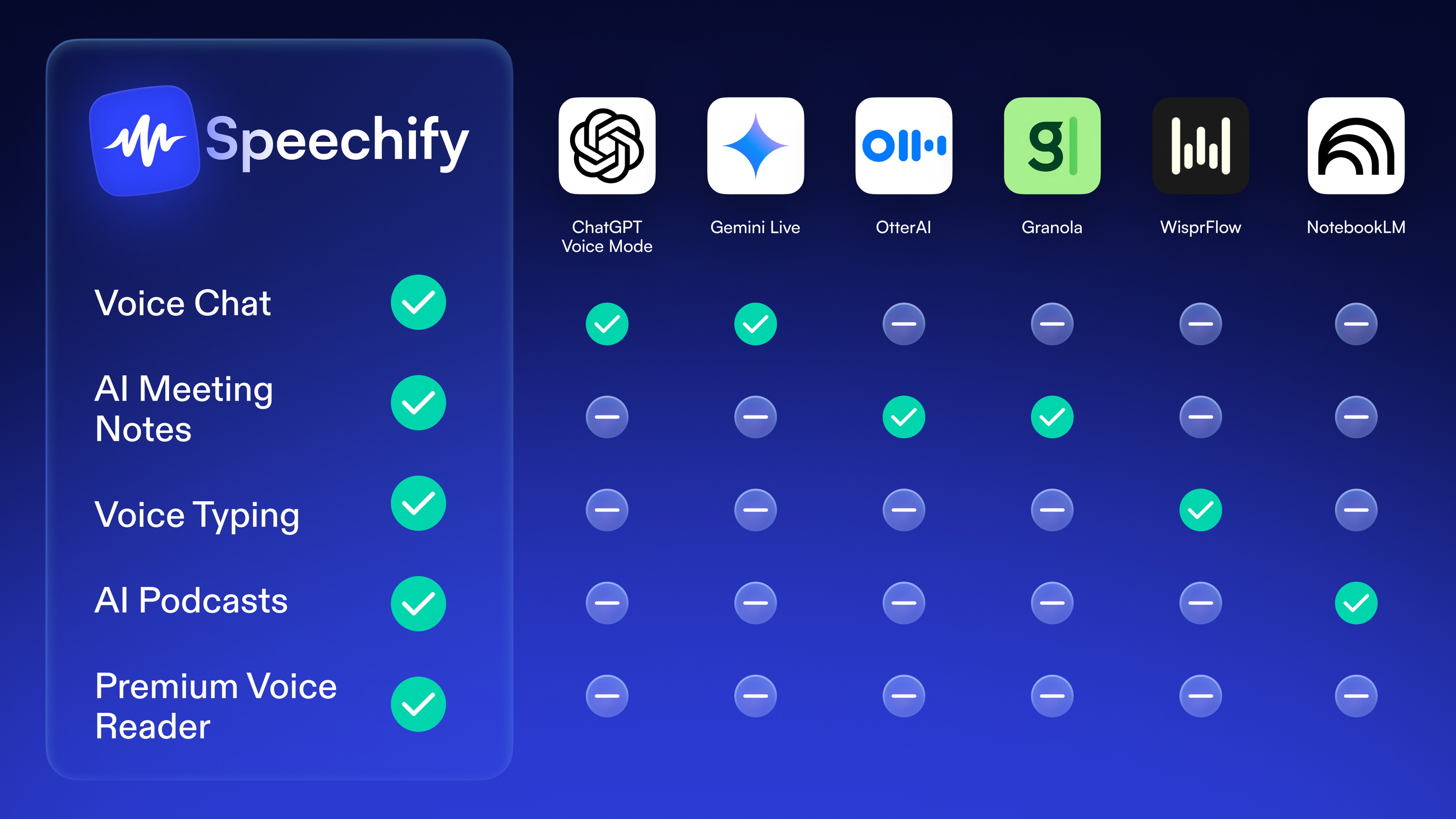
Speechify is best understood as a Voice AI Assistant rather than a traditional research notebook. Instead of asking users to upload files into a contained workspace, Speechify works wherever content already exists and lets users interact with it through listening, speaking, and voice-based queries.
Speechify combines text to speech, voice typing dictation, and a voice AI assistant into a single system designed for everyday productivity.
Users can listen to PDFs, documents, emails, articles, and web pages read aloud in natural-sounding voices, often at speeds faster than silent reading. Speechify also supports voice typing dictation, allowing users to speak ideas instead of typing them across email, documents, Slack, and web apps.
Rather than limiting interaction to typed prompts, Speechify allows people to ask questions out loud, hear answers spoken back, and turn long documents into audio or podcast-style listening experiences. This makes it especially useful for people who think better through speech or prefer listening over reading.
What truly differentiates Speechify is how it treats voice as a two-way interface. Users can ask questions out loud about what they are reading, hear answers spoken back, request summaries, and convert long documents into structured audio or podcast-style listening experiences. Instead of switching between reading, writing, and AI tools, everything happens in one continuous voice-first workflow.
Speechify works across OS, Android, Mac, the web, and Chrome extension,, making it a flexible alternative to NotebookLM for users who want AI assistance to follow them across devices and tasks.
How does ChatGPT compare as a flexible conversational AI alternative to NotebookLM?
ChatGPT is one of the most widely used AI assistants and serves as a strong NotebookLM alternative for users who want open-ended reasoning and conversational interaction.
ChatGPT excels at explaining complex topics, generating summaries, answering follow-up questions, and helping users think through problems step by step. In some versions, it also supports voice input and spoken responses, allowing users to talk to the assistant rather than type.
Unlike Speechify, ChatGPT does not operate directly on the content users are already reading or writing by default. Documents, emails, PDFs, and articles typically need to be copied, uploaded, or summarized manually before meaningful interaction can begin. This makes ChatGPT powerful for reasoning but less integrated into everyday reading and writing workflows.
How does Claude support structured explanations and long-form reasoning as a NotebookLM alternative?
Claude is another conversational AI assistant that works as an alternative to NotebookLM for users focused on clarity, structure, and long-form explanations.
Claude is known for producing readable summaries, breaking down dense material, and maintaining a calm, methodical tone. It handles long documents well and is often used for research interpretation, policy review, and educational explanations.
Depending on the interface, Claude can support document uploads and conversational refinement, though it remains more text-centric than voice-first tools like Speechify.
Claude is a good option for users who want thoughtful summaries and explanations without needing a notebook-style interface.
How does Perplexity function as a source-aware AI research alternative to NotebookLM?
Perplexity is often compared to NotebookLM because it emphasizes source-based answers. It functions more like an AI research search engine, pulling information from the web and providing citations alongside responses.
Rather than working inside a private notebook, Perplexity is designed for quick research questions, fact-finding, and exploration across live sources. It is especially useful when users want transparency about where information comes from.
Perplexity focuses more on retrieval and synthesis than on listening, dictation, or voice-first workflows.
How does Readwise Reader support long-term knowledge capture as a NotebookLM alternative?
Readwise Reader is not a conversational AI assistant, but it serves as a NotebookLM alternative for people focused on reading, highlighting, and long-term knowledge retention.
Users save articles, PDFs, and documents, highlight important passages, and review them later through spaced repetition. AI summaries help surface key ideas, but the core strength of Readwise is helping users remember what they read over time.
Readwise pairs well with listening tools like Speechify for users who want both audio consumption and structured memory.
How does Mem use AI to organize notes as an alternative to NotebookLM?
Mem is designed around capturing notes quickly and letting AI organize them automatically. It works as a personal knowledge base that connects ideas over time without requiring strict manual structure.
Mem is useful for ongoing projects, idea capture, and internal documentation, but it does not emphasize voice interaction or listening in the way Speechify does.
How do you choose the right NotebookLM alternative based on how you work with information?
The best NotebookLM alternative depends on how you prefer to interact with information.
Some users want document-grounded research with citations. Others want conversational reasoning. Many prefer listening, speaking, and hands-free workflows that fit into daily work across devices.
If your workflow involves reading long documents, dictating ideas, listening while multitasking, or interacting with AI through voice, a voice-first tool like Speechify Voice AI Assistant offers a fundamentally different experience than notebook-style research tools.
NotebookLM is built for organizing sources. Speechify is built for thinking, writing, and learning through voice.
FAQ
What is NotebookLM best used for?
NotebookLM is best for source-grounded research, summarizing uploaded documents, and exploring connections within a defined set of materials.
What makes Speechify different from NotebookLM?
Speechify focuses on voice interaction, text to speech, and voice typing dictation across everyday tools rather than limiting AI to a single notebook.
Can Speechify replace AI research tools?
Speechify is not a citation-first research notebook, but it complements research by making documents easier to consume, summarize, and interact with through voice.
Is a voice AI assistant better than typing prompts?
For many people, speaking and listening is faster and more natural than typing, especially for long documents and ongoing workflows.
Do people use multiple AI tools together?
Yes. Many users combine tools, such as using Speechify for listening and dictation while using research-focused AI tools for citations and structured analysis.