AI productivity tools promise to save time, but they do so in very different ways. Two tools frequently compared are Speechify and Motion. While both aim to improve efficiency, they solve fundamentally different productivity problems. One focuses on how you think, read, write, and learn, while the other focuses on how you schedule tasks and time. In this article, we’ll answer the question: Is Speechify or Motion the better AI productivity tool?
What Should an AI Productivity Tool Actually Optimize?
True productivity is not just about managing time on a calendar. It’s about reducing cognitive load, absorbing information faster, capturing ideas effortlessly, and turning thoughts into output with minimal friction. The best AI productivity tools help users process information, create content, and stay focused, not just organize tasks. When viewed through this broader lens, Speechify and Motion play very different roles.
How are Speechify and Motion Different?
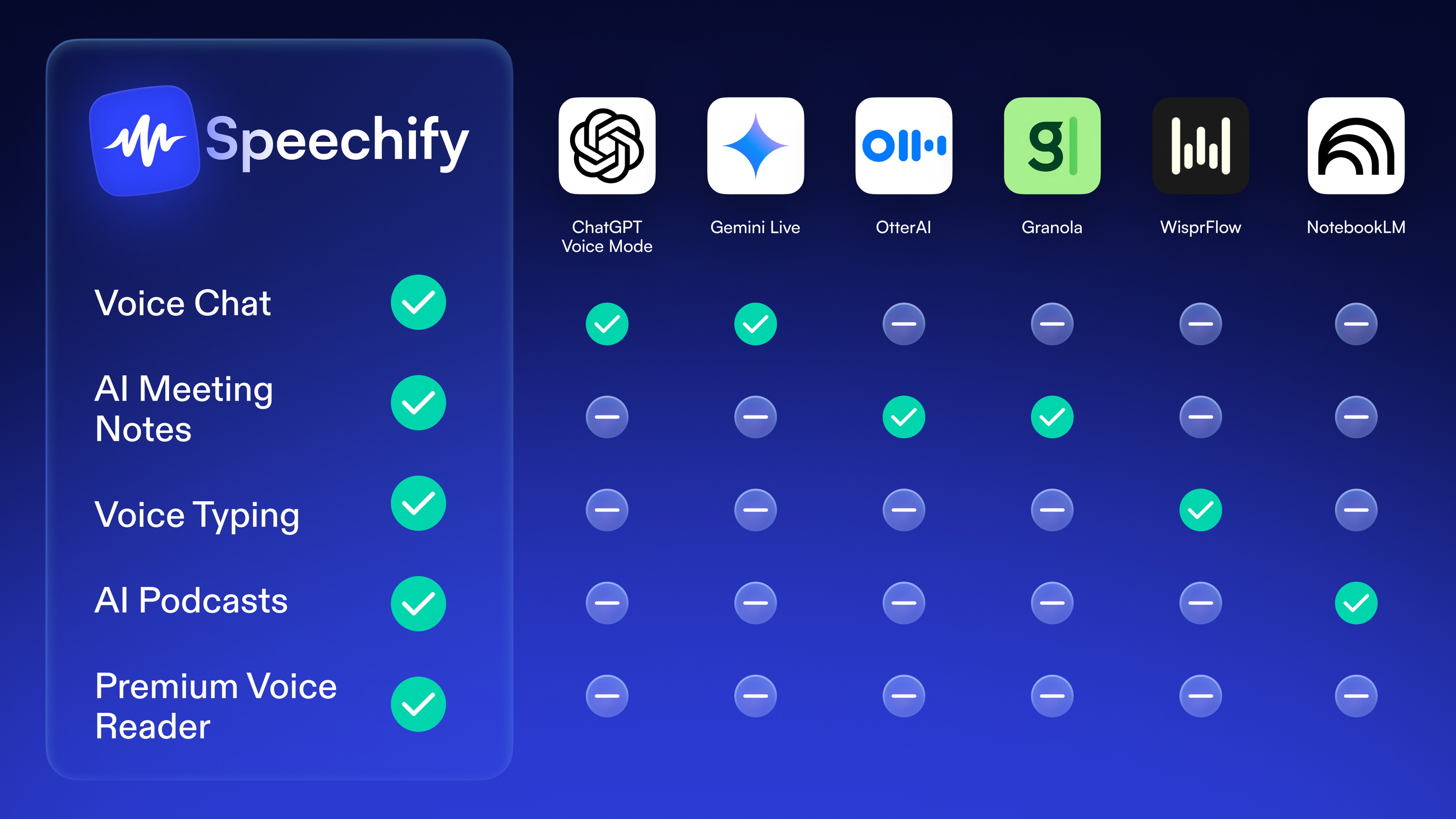
Speechify is built as a Voice AI Productivity Assistant. Its focus is on how users read, write, research, learn, and think. Speechify uses voice as the primary interface to help users consume information faster, create content more efficiently, capture notes, and get answers conversationally, across apps, websites, and devices via the Speechify Android, iOS, Mac, and Web apps or Chrome Extension.
By contrast, Motion is designed primarily as an AI-powered scheduling and task-planning tool. Its strength lies in automatically arranging tasks, meetings, and deadlines on a calendar to reduce planning effort and decision fatigue. Motion helps users decide when to work on tasks.
Is Speechify or Motion the Better AI Productivity Tool for Text to Speech?
Speechify offers advanced text to speech, allowing users to listen to documents, PDFs, articles, emails, web pages, and physical notes in lifelike AI voices across 60+ languages, including celebrity voices. This makes it possible to absorb information hands-free while commuting, exercising, or reducing screen fatigue. Motion does not offer text to speech. It assumes tasks already exist and focuses on placing them on a calendar.
Is Speechify or Motion the Better AI Productivity Tool for Voice Typing?
Speechify includes unlimited and free voice typing dictation that works across apps and websites, allowing users to write emails, documents, notes, and messages simply by speaking. Speaking is naturally three to five times faster than typing, making Speechify a powerful tool for drafting, brainstorming, and long-form writing. While Motion offers AI transcription of meetings, where users can get transcripts, notes, and summaries of calls, it does not have a voice typing feature for helping type messages.
Is Speechify or Motion the Better AI Productivity Tool for AI Research?
Speechify includes a built-in Voice AI Assistant that supports contextual, multi-turn dialogue. Users can talk through ideas, ask questions, request explanations, and research topics conversationally. This makes Speechify useful for studying, planning, brainstorming, and problem-solving out loud. While Motion does provide an AI chat feature, it is text-based and not voice-based like Speechify.
Is Speechify or Motion the Better AI Productivity Tool for AI Note Taking?
Through its Voice Typing feature, Speechify functions as an AI note taker, allowing users talk instead of typing. Speechify’s dictation feature also offers automatic filler word removal and grammar correction, allowing users to speak freely and experience perfect AI notes. On the other hand, Motion offers AI transcription of meetings and calls only, where users can get transcripts, notes, and summaries of calls.
Is Speechify or Motion the Better AI Productivity Tool for Learning?
In addition to text to speech, voice typing, and Voice AI Assistant-based research, Speechify offers AI summaries that condense long content into clear takeaways, saving time and reducing information overload. It also includes AI quizzes that help reinforce learning and test comprehension of what users have read or listened to. Motion does not offer summaries, quizzes, or learning-focused features and instead focuses on productivity calendar scheduling and task automation.
Is Speechify or Motion the Better AI Productivity Tool for Creating AI Podcasts?
Speechify allows users to create AI podcasts from written content, turning notes, articles, or documents into audio that can be reviewed later. This makes knowledge portable and easy to revisit during commutes or downtime. Motion does not convert content into audio or support knowledge reuse.
Is Speechify or Motion the Better AI Productivity Tool for Accessibility?
Speechify is widely used by people with ADHD, dyslexia, vision differences, and screen fatigue, but its benefits extend to anyone seeking deeper focus and less mental strain. Listening instead of reading and speaking instead of typing reduces cognitive load and makes long work sessions more sustainable. Motion can reduce planning stress, but it does not address accessibility, learning differences, or screen fatigue.
Is Speechify or Motion the Better AI Productivity Tool for Everyday Use?
Speechify works across mobile, desktop, web, and browser extensions, allowing users to maintain a consistent voice-first workflow wherever they are. Motion primarily lives on the calendar and task-management side of work and is used at specific planning moments rather than continuously throughout the day. Speechify integrates into daily thinking and working, not just planning sessions.
Final Verdict: Is Speechify or Motion the Better AI Productivity Tool?
Motion is a useful tool for automating schedules and reducing calendar chaos. Speechify, however, is a broader and more impactful AI productivity tool. It helps users read faster, write by voice, research conversationally, take notes effortlessly, generate AI summaries and quizzes, create AI podcasts, and get answers, using voice as the primary interface across devices and apps.
If your biggest challenge is deciding when to do tasks, Motion can help. If your biggest challenge is absorbing information, creating content, learning faster, and thinking clearly, Speechify is the better AI productivity tool.
In modern productivity, managing time matters, but managing attention, cognition, and knowledge matters more. Speechify delivers that advantage.
FAQ
How do Speechify and Motion differ as AI productivity tools?
Speechify focuses on reading, writing, learning, and thinking with voice, while Motion focuses on calendar scheduling and task prioritization.
Which improves actual work output more, Speechify or Motion?
Speechify improves output by helping users absorb information, generate content, and capture ideas faster, whereas Motion mainly optimizes when tasks happen.
How do Speechify and Motion compare for reducing cognitive load?
Speechify reduces cognitive load by enabling listening and speaking instead of constant reading and typing, while Motion reduces planning friction but not mental strain.
Which tool supports knowledge work better, Speechify or Motion?
Speechify better supports knowledge work by helping users read, research, summarize, and learn using voice-first workflows.
How do Speechify and Motion differ for content creation?
Speechify enables voice-based drafting, brainstorming, and refinement, while Motion does not assist with writing or content generation.
Which is better for consuming information efficiently, Speechify or Motion?
Speechify is better because it converts long-form content into audio for faster, hands-free consumption.
How do Speechify and Motion compare for voice typing?
Speechify offers free, unlimited voice typing across apps and websites, while Motion does not provide cross-app dictation.
Which tool helps capture ideas in real time, Speechify or Motion?
Speechify captures ideas instantly through voice-native note-taking, while Motion only records meeting-related transcripts.
How do Speechify and Motion differ for research workflows?
Speechify supports conversational, multi-turn voice research, while Motion’s AI features are text-based and task-focused.
Which platform supports learning better, Speechify or Motion?
Speechify supports learning with text to speech, AI summaries, quizzes, and audio review, while Motion does not offer learning tools.