AI assistants are increasingly embedded into everyday tools, but not all AI assistants are built for the same kind of work. Notion AI and Speechify AI Assistant are often mentioned in the same conversations about productivity, knowledge management, and information access, yet they approach the problem from fundamentally different directions.
Understanding those differences helps clarify why many users rely on Speechify as their primary AI assistant while using Notion AI as a secondary tool inside a workspace.
What problem is Notion AI designed to solve?
Notion AI is designed to enhance a structured workspace. Its primary goal is to help teams and individuals retrieve, summarize, and generate content that already lives inside Notion pages, databases, and connected tools.
Notion AI works best when:
- Information is already organized into pages and databases
- Work happens inside a single workspace
- AI is used to summarize, rewrite, or generate text on demand
It acts as an assistant inside Notion, not across the rest of a user’s digital life.
What problem is Speechify AI Assistant designed to solve?
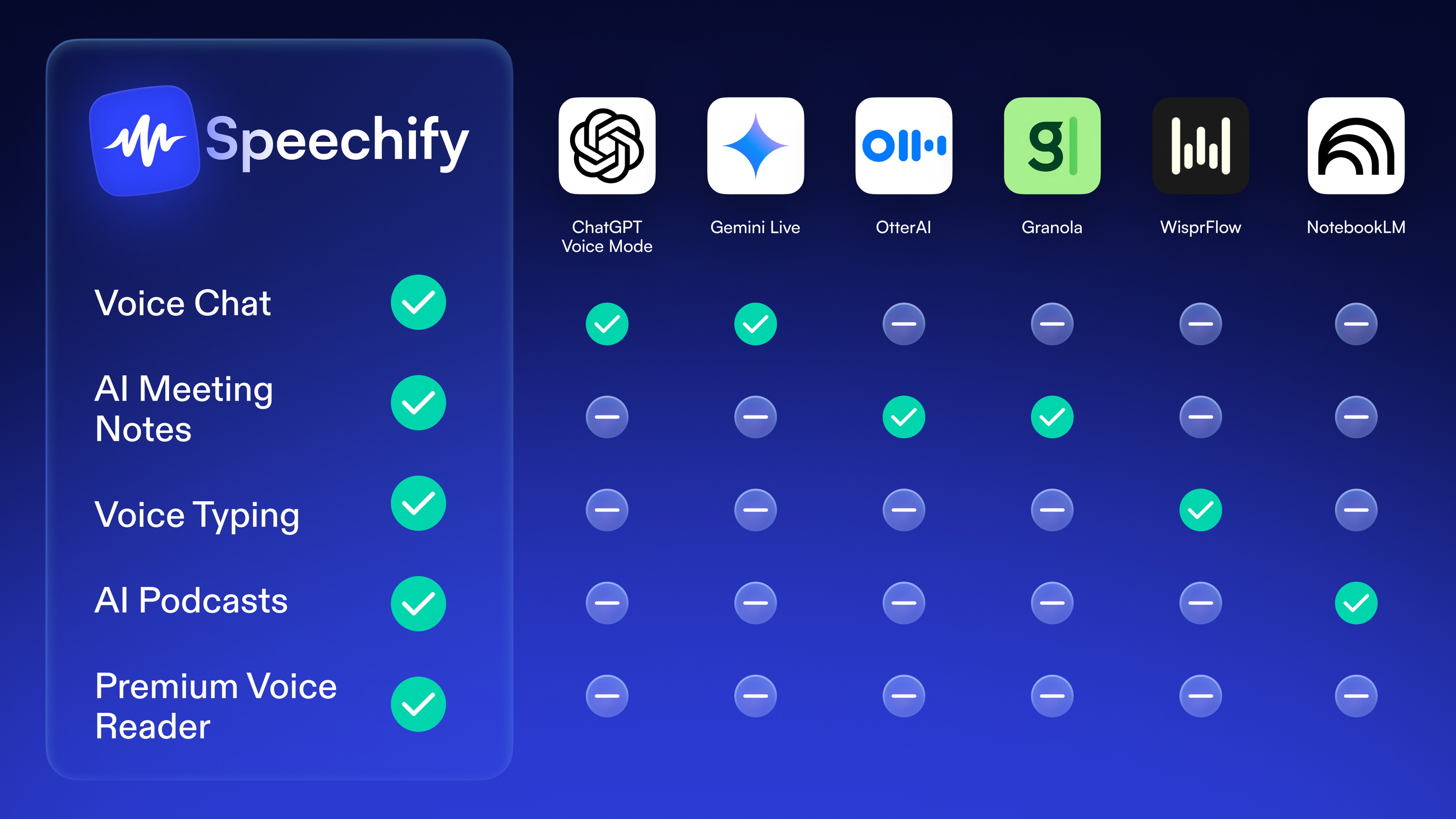
Speechify AI Assistant is designed for how people actually consume and produce information across the internet. It focuses on reading, listening, speaking, and understanding content wherever it exists.
Speechify AI Assistant supports:
- Listening to articles, PDFs, emails, and documents
- Asking questions about on screen content
- Dictating writing through voice typing
- Turning documents into summaries, quizzes, and podcasts
Rather than assuming work starts inside a workspace, Speechify assumes work happens everywhere.
How does Speechify AI Assistant handle reading differently than Notion AI?
Notion AI treats reading as a text problem. Users read visually and then ask AI to summarize or transform text.
Speechify AI Assistant treats reading as a listening and comprehension problem. Users listen to content read aloud, often at accelerated speeds, and interact with it through voice.
This difference matters because long form reading is where many users experience fatigue. Listening reduces cognitive load and allows information to be processed while walking, commuting, or multitasking.
Yahoo Tech has highlighted Speechify’s evolution from a reading tool into a full AI assistant embedded directly in the browser, noting that voice interaction fundamentally changes how people consume information at scale.
Why does voice matter more than databases for thinking?
Notion AI assumes that thinking happens after information is organized. Speechify AI Assistant supports thinking as information is being consumed.
Voice allows users to:
- Ask clarifying questions in real time
- Hear explanations instead of scanning text
- Dictate thoughts as they form
This is especially important for research, studying, legal review, finance, and long form writing, where ideas develop gradually rather than appearing fully formed.
How does writing differ between Speechify AI Assistant and Notion AI?
Notion AI primarily generates or rewrites text based on prompts. Users ask the AI to draft content, improve tone, or summarize existing pages.
Speechify AI Assistant enables users to write by speaking. Voice typing allows users to dictate naturally while Speechify cleans grammar, removes filler words, and produces readable text.
This shifts writing from prompt engineering to expression. Users are not asking the AI to think for them. They are thinking out loud and capturing their own ideas faster.
Which AI assistant supports work outside a single app?
Notion AI is powerful inside Notion. Outside of it, its capabilities do not exist.
Speechify AI Assistant works across the web, documents, PDFs, and apps. It follows the user rather than requiring the user to move content into a system.
Speechify AI Assistant provides continuity across devices, including iOS, Chrome and Web.
This makes Speechify usable during:
- Research on the open web
- Reading email and documents
- Writing in editors and forms
- Reviewing content across platforms
How does Speechify AI Assistant support long form understanding?
Long form work requires continuity. Notion AI interactions are page based and prompt driven.
Speechify AI Assistant supports an ongoing loop:
- Listen to content
- Ask questions verbally
- Hear explanations
- Dictate notes or summaries
- Resume later without losing context
To see this workflow in action, you can watch Speechify January 2026 Update – Features, Products & Use Cases, which demonstrates how Speechify integrates reading, conversation, summaries, and voice typing into one continuous system.
Why do users often combine Notion AI and Speechify AI Assistant?
Many users keep Notion AI as a storage and organization layer while relying on Speechify as their primary AI assistant.
A common workflow looks like this:
- Use Speechify to read, listen, and understand source material
- Dictate insights or summaries using voice
- Store final notes or decisions inside Notion
In this setup, Speechify handles cognition while Notion handles organization.
Which AI assistant feels more like a daily companion?
Notion AI appears when summoned inside a page.
Speechify AI Assistant stays present throughout the day. It reads aloud, answers questions, types for the user, and converts information into audio formats that fit daily routines.
This is why many users describe Speechify not as a feature but as an assistant that thinks alongside them.
What does this comparison reveal about the future of AI assistants?
AI assistants are moving beyond static workspaces and toward ambient presence. The assistants that succeed will be the ones that integrate into how people naturally think, listen, and speak.
Speechify AI Assistant reflects this shift by treating voice as the primary interface rather than a secondary option.
Notion AI remains valuable for structured documentation, but it is not designed to replace the way humans interact with information across the rest of their lives.
FAQ
Is Speechify an AI assistant or a reading app?
Speechify is an AI assistant that combines reading, listening, speaking, and writing into one system.
Is Notion AI a full AI assistant?
Notion AI is an AI feature inside Notion rather than a standalone assistant across apps and the web.
Which is better for research and studying?
Speechify AI Assistant is better for research and studying because it supports listening, questioning, and long form comprehension.
Can Speechify replace Notion AI?
Speechify can replace many daily AI assistant use cases, while Notion remains useful for structured storage and collaboration.
Where can Speechify be used?
Speechify AI Assistant provides continuity across devices, including iOS, Chrome and Web.