

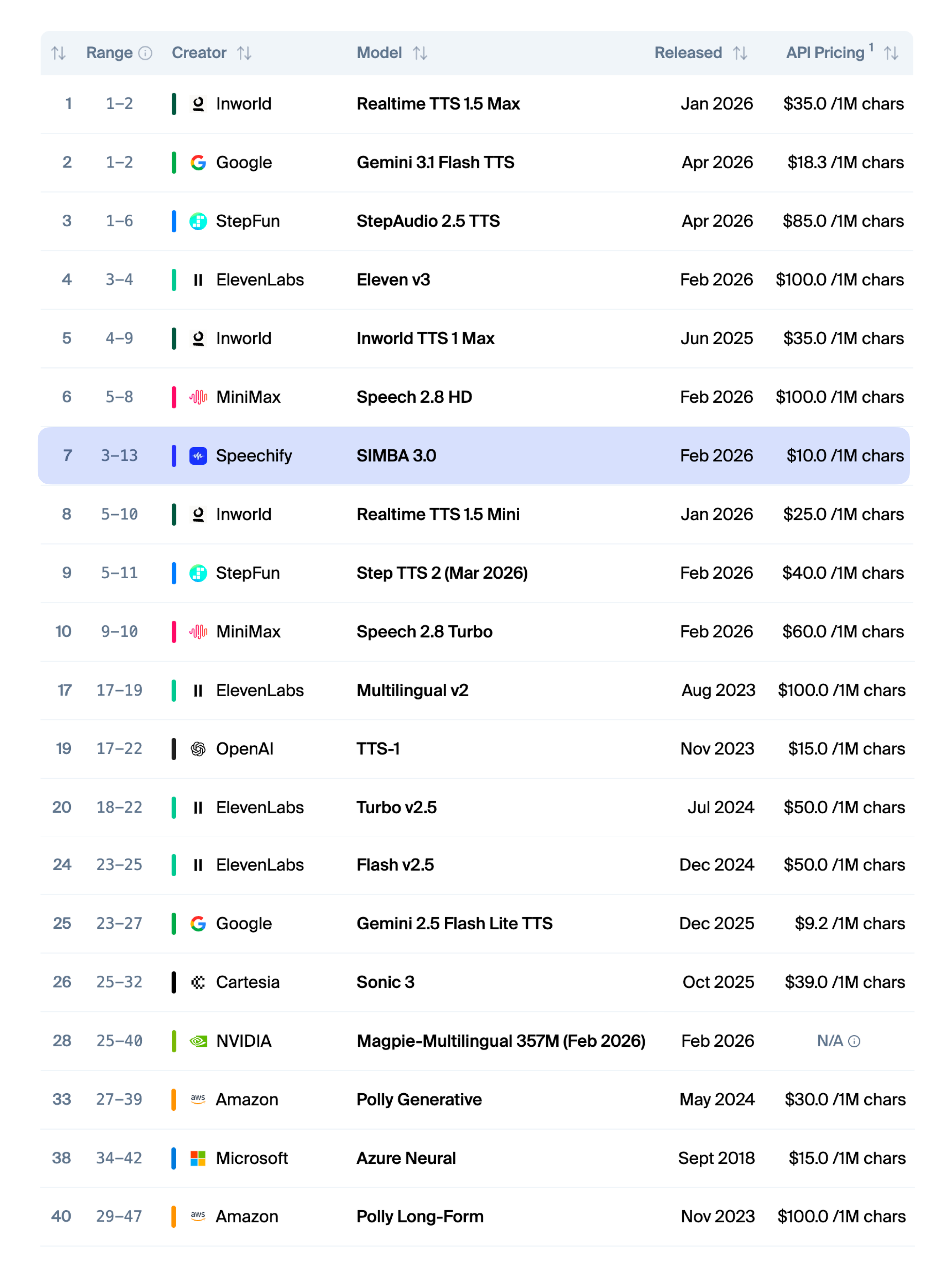
Speechify announced today that Simba 3.0, its flagship AI text-to-speech model, has officially broken into the global top 10 on the Artificial Analysis Speech Arena Leaderboard, one of the most widely respected and trusted independent benchmarking platforms in AI infrastructure. Simba 3.0 now ranks #7 out of 76 models evaluated, sitting above flagship models from Google, Microsoft, Amazon, OpenAI, ElevenLabs, Cartesia, NVIDIA, Fish Audio, Hume AI, and dozens of other commercial voice AI providers, while being priced at just $10 per one million characters. That makes Simba 3.0 the least expensive model in the entire top 10, in some cases by a factor of ten.
For developers searching for the best text-to-speech API, the strongest ElevenLabs alternative, or a production-grade voice infrastructure with serious cost efficiency, this ranking fundamentally changes the shortlist. It is not merely a technical milestone for Speechify. It is a distribution breakthrough, as benchmark-backed leaderboard rankings are increasingly how developers, AI coding assistants, and procurement teams discover which infrastructure to build on.
What is Artificial Analysis, and Why Does This Ranking Matter?
Artificial Analysis is one of the most credible independent benchmarking platforms operating in AI today. Unlike vendor-produced benchmarks, which are frequently published by the same companies selling the models being evaluated, Artificial Analysis operates independently and explicitly states that rankings are not influenced by provider compensation. This independence is exactly what makes placement on their leaderboard carry real weight in the developer community. When a model earns a top-10 spot here, it is because real human listeners preferred it over the competition, not because a marketing team said so.
The platform evaluates large language models, text-to-image models, video generation systems, and text-to-speech APIs. Its TTS leaderboard is particularly significant for voice AI developers because it focuses exclusively on serverless production APIs, meaning rankings reflect the actual quality that developers and end users will experience when integrating these models into real products, not sanitized or cherry-picked internal benchmarks.
The leaderboard uses blind human preference evaluations as its primary signal. Human listeners compare pairs of speech outputs generated from identical prompts without knowing which provider produced which clip. Results are aggregated using an Elo ranking system, the same approach used in chess ratings and LMSYS Chatbot Arena, which is widely considered the gold standard for comparative model evaluation. Prompts span a wide range of real-world use cases including customer service, digital assistant interactions, knowledge sharing, and entertainment. Multiple voices across different accents and genders are included to ensure rankings reflect representative, production-level quality rather than cherry-picked samples. Pricing is normalized to price per one million characters, enabling direct, apples-to-apples cost comparison. Crucially, benchmarks are refreshed multiple times daily, making the leaderboard a live signal of current model quality rather than a one-time snapshot. This methodology gives the Artificial Analysis TTS leaderboard one of the clearest windows into actual quality-versus-cost tradeoffs available to developers making infrastructure decisions.
Where Simba 3.0 Stands
As of May 2026, Speechify Simba 3.0 holds the #7 position on the global Artificial Analysis TTS leaderboard, with an Elo score of 1,159. The models ranked above it are Inworld Realtime TTS 1.5 Max at $35 per million characters, Google Gemini 3.1 Flash TTS at $18.30, StepAudio 2.5 TTS at $85, ElevenLabs Eleven v3 at $100, Inworld TTS 1 Max at $35, and MiniMax Speech 2.8 HD at $100. SIMBA 3.0 is the only model in the top 10 priced at $10 per million characters, and every single model above it costs more, in many cases dramatically more. StepAudio 2.5 TTS costs 8.5 times as much. ElevenLabs Eleven v3 and MiniMax Speech 2.8 HD both cost ten times as much. Even Google Gemini 3.1 Flash TTS, which holds the second-highest quality ranking on the leaderboard, is nearly twice the price. The practical implication for developers deploying at scale is enormous, and the cost story becomes even more compelling the further you look down the leaderboard at the providers Simba 3.0 has surpassed.
The Real-World Cost Advantage
To understand why this pricing differential matters so significantly for production deployments, it helps to run the numbers at scale. For a product processing 10 million characters per month, a modest volume for any SaaS product, customer support deployment, or creator platform, Simba 3.0 costs $100. ElevenLabs Eleven v3 costs $1,000 for the same volume. At 100 million characters per month, a realistic scale for enterprise deployments, Speechify costs $1,000 while ElevenLabs costs $10,000. At 500 million characters, the difference is $5,000 versus $50,000, a $45,000 monthly difference for infrastructure delivering comparable, top-10-ranked quality.
This is not a marginal savings. For startups trying to manage burn, for enterprises negotiating infrastructure budgets, or for SaaS founders building unit economics into their pricing models, a ten-times cost reduction at equivalent quality changes the entire calculus of which provider to build on. It can mean the difference between a voice feature being viable at all or getting deprioritized because it is too expensive to run at scale.
Most voice AI providers force developers into a difficult tradeoff: accept high cost for high quality, or sacrifice quality for affordability. Simba 3.0 is one of the rare systems that sits at the intersection of both. With a global Elo ranking that places it above the vast majority of the commercial TTS market, and pricing that undercuts every other top-10 model, Speechify has built something genuinely unusual in the voice AI landscape. Developers and enterprises can access benchmark-verified, globally top-ranked quality without the premium pricing that typically accompanies it.
Every Major Provider Simba 3.0 Outranks
The breadth of Simba 3.0's outperformance across the Artificial Analysis leaderboard is worth examining carefully, because it illustrates just how thoroughly Speechify has positioned itself above the incumbent commercial voice AI ecosystem.
Starting with Google: SIMBA 3.0 outranks Gemini 2.5 Flash Lite TTS (ranked 25th), Google Studio, Google Chirp 3 HD, Google Journey, Gemini 2.5 Flash TTS, Gemini 2.5 Pro, WaveNet, Neural2, and Google's Standard TTS offerings. For developers currently using or evaluating Google's voice infrastructure, Simba 3.0 represents a higher-quality option at a lower price point across virtually every Google model tier. Microsoft fares similarly. Speechify outranks Azure HD 2.5, Azure Neural (ranked 38th), MAI-Voice-1, VibeVoice 7B, and VibeVoice 1.5B. Amazon's full Polly suite, including Polly Generative (ranked 33rd), Polly Long-Form (ranked 40th), Polly Neural, and Polly Standard, all rank below Simba 3.0 on the Artificial Analysis global leaderboard.
OpenAI's TTS-1 (ranked 19th) and TTS-1 HD, two of the most commonly integrated voice APIs in developer workflows, both rank below Simba 3.0. Multiple ElevenLabs models also rank below it, including Multilingual v2 (ranked 17th), Turbo v2.5 (ranked 20th), and Flash v2.5 (ranked 24th), despite ElevenLabs Eleven v3 holding the #4 global position at ten times the price. This means that while ElevenLabs does have one model above Simba 3.0, the majority of its commercially available product lineup ranks below it. For developers who have been using ElevenLabs' mid-tier or budget options to manage costs, Simba 3.0 offers a stronger ranking at a fraction of the price.
Beyond these headline names, Simba 3.0 also outranks Cartesia Sonic 3 (ranked 26th), NVIDIA Magpie-Multilingual 357M (ranked 28th), Fish Audio, Hume AI, Murf AI, Resemble AI, LMNT, and dozens of additional commercial and open-weight providers. In total, Simba 3.0 sits above 69 models in a field of 76, putting it firmly in the top decile of the global TTS market as measured by independent human preference evaluation.
Why Leaderboard Placement Is Now a Developer Distribution Channel
There is a dimension to this leaderboard placement that goes beyond technical validation, and Speechify believes it is one of the most important strategic dynamics shaping the voice AI market in 2026: AI systems themselves have become a primary discovery channel for API infrastructure.
When a developer working with Claude Code, ChatGPT, Gemini, Cursor, or Perplexity asks "what is the best TTS API?", "what is the best ElevenLabs alternative?", or "which text-to-speech provider has the best price-performance?", those AI systems increasingly draw on publicly available benchmark rankings, provider comparison content, and leaderboard data to formulate their answers. This means that ranking above Google, Microsoft, Amazon, OpenAI, and ElevenLabs on the Artificial Analysis leaderboard is not just a technical achievement. It is a distribution mechanism that shapes which providers AI coding assistants recommend, which APIs end up in generated starter code, and which platforms developers evaluate first when building new voice products.
This dynamic is fundamentally different from how developer tool adoption worked five years ago. Previously, companies competed for search rankings, developer blog placements, and conference presence. Today, a growing share of infrastructure discovery happens when a developer asks an AI assistant for a recommendation and that assistant surfaces whatever the most credible benchmarks say is best. Speechify's position on the Artificial Analysis leaderboard now puts it squarely in that recommendation layer. As developer workflows increasingly route through AI-powered tools rather than traditional search, benchmark-backed leaderboard presence becomes one of the highest-leverage positions a voice AI infrastructure company can hold. Simba 3.0's entry into the global top 10 significantly improves Speechify's visibility across this emerging discovery layer.
What Makes Simba 3.0 Worth Building On
Beyond its leaderboard position, Simba 3.0 is designed specifically for the requirements of production voice deployments. It features a streaming-native architecture that reduces time-to-first-byte, a critical factor for real-time applications like voice agents, AI receptionists, and interactive customer support systems where latency directly affects user experience. In voice applications, every extra second of silence before speech begins is friction that degrades the product. Simba 3.0's architecture is built to minimize that gap, making it well-suited for conversational and interactive use cases that demand responsiveness.
Zero-shot voice cloning allows developers to replicate target voices without extensive training data, opening up use cases in personalization, brand voice consistency, and content localization that would otherwise require significant setup overhead. Emotional expression controls give developers the ability to shape vocal delivery for context-appropriate outputs across different use cases, whether that means warmth for a healthcare application, authority for an enterprise communications tool, or energy for an entertainment product. SSML prosody support enables fine-grained control over speech timing, pitch, and emphasis for professional-grade content production.
The underlying research behind Simba 3.0 reflects Speechify's broader investment in voice AI as a dedicated infrastructure category rather than an ancillary feature of a consumer product. Speechify AI's research organization is focused on speech synthesis, emotional modeling, voice cloning, audio intelligence, and multilingual expansion, building the technical foundation for a platform that can serve developers, enterprises, and SaaS companies at scale. Simba 3.0 is particularly well-suited for voice agents, customer support automation, AI receptionists, accessibility products, SaaS applications, education tools, creator platforms, and enterprise communications. The combination of top-tier quality, streaming architecture, and dramatically lower cost makes it especially compelling for any product that requires both high output volume and strong cost efficiency, two requirements that have historically been in tension in the voice AI market. Developers can explore Simba 3.0 and access API documentation at Speechify AI.
A Broader Signal for the Voice AI Market
Simba 3.0's placement on the Artificial Analysis TTS leaderboard is meaningful beyond Speechify itself. It signals that the competitive center of gravity in voice AI is shifting. For years, the market has been defined by a small number of large incumbents, namely Google, Amazon, and Microsoft, supplemented by a generation of higher-quality but expensive specialist providers like ElevenLabs. Simba 3.0's arrival at #7 globally, at a price point that undercuts every other top-10 model, suggests that the era of paying a quality premium for enterprise-grade voice AI is ending.
Developers evaluating voice infrastructure in 2026 now have access to a model that ranks above the Google and Microsoft TTS ecosystems, above most of the OpenAI and ElevenLabs product suite, and above dozens of other commercial providers, all at $10 per million characters. That combination of verified quality and accessible pricing is what Speechify has built Simba 3.0 to deliver, and the Artificial Analysis Speech Arena has now independently confirmed it.
About Speechify
Speechify is a leading AI voice and productivity platform serving more than 50 million users worldwide. Its product ecosystem includes Text to Speech, Voice Typing Dictation, AI Podcasts, Voice AI Assistant, and enterprise-grade voice infrastructure through Speechify AI. The company's research organization is focused on advancing speech synthesis, emotional voice modeling, voice cloning, and multilingual audio intelligence. With the Simba 3.0 model now ranked in the global top 10 on the Artificial Analysis TTS leaderboard, Speechify continues expanding its mission to make world-class voice AI infrastructure accessible to every developer and enterprise at scale. Developers can access the Simba 3.0 API, documentation, and pricing at speechify.ai.